USDT: How the Market's Main Stablecoin Works
The short answer to what is USDT: it is a digital dollar from the company Tether, issued on a blockchain and worth about one US dollar. The coin belongs to the stablecoins - the class of cryptocurrencies pegged to an external asset. Below is how it works and where it is used (as of July 2026).
_Last updated: August 4, 2026. Prepared and fact-checked by the EIDEX editorial team; the sources and the method are described at the end of the article._
What Stands Behind the Coin
Tether accepts dollars from clients and issues an equivalent number of tokens, keeping the reserves in cash and short-term government bonds. The reverse operation is possible too: the issuer redeems the coins and returns the money.
That is exactly why the price holds near one dollar. When it drifts, arbitrageurs buy up or sell the tokens and the market levels out. The asset differs from the rest of the cryptocurrencies in principle: the value of bitcoin is set by demand alone, while here a company's obligation stands behind it.
The scale of that obligation is what makes the coin systemically important. USDT accounts for about $183 billion of circulating supply and roughly 64% of the entire stablecoin market as of early August 2026; together with USDC the two of them hold close to 89% of it. No other token in this class is close.
Reserve Reports Are the Document to Read
The issuer discloses reserves through regular reports. This is the key document for a holder: it shows what share of the backing sits in liquid instruments and what share sits in riskier ones. A full audit by one of the big four firms is the long-standing complaint of critics, and the distinction matters - an attestation confirms a snapshot of balances, an audit tests the controls that produce them.
Why the Coin Is So Popular
The reason is utilitarian. Moving value between venues needs an asset that does not jump in price, and among cryptocurrencies only stablecoins meet that requirement. The numbers show how far that has gone: stablecoins accounted for about three quarters of all crypto trading volume in the first quarter of 2026, and settled an estimated $46 trillion in transfers during 2025 - more than twenty times PayPal's annual volume.
- Settlements. A blockchain transfer takes minutes and costs cents, whereas an international bank payment takes days.
- Holding a position. A trader exits a volatile asset into a stablecoin and stays in dollar terms without withdrawing funds.
- Access to the market. On exchanges most pairs trade against this coin rather than against national currencies.
- A dollar equivalent without a bank. In countries with an unstable currency this is a way to keep savings in a familiar unit of account.
Which Networks USDT Is Issued On
The coin exists on dozens of blockchains at once. The backing is shared and the issuer is one, but the delivery routes differ - and the cost of a transfer depends on the choice.
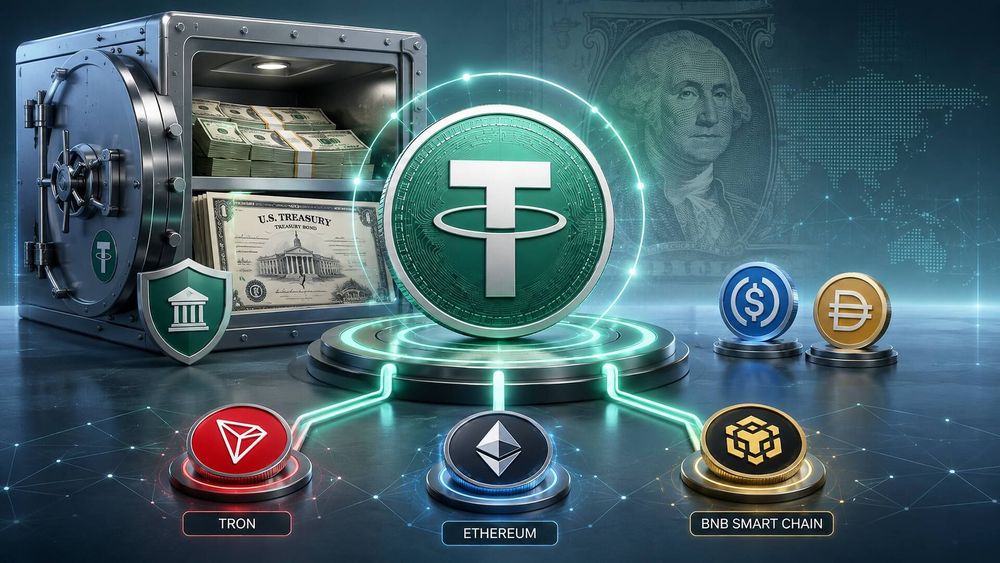
Three formats are the most common. The version on the TRON network is cheaper than the rest and therefore dominates private transfers: TRON holds roughly $85 billion of USDT, which is more than 97% of all stablecoin liquidity on that chain. The details are collected in the glossary entry on the TRC20 network. The format for Ethereum is supported almost everywhere, and that chain carries the largest stablecoin balance overall - about $170 billion, close to 60% of global supply - but the fee there is higher and grows with load. The third option runs on BNB Smart Chain, covered in the entry on the BEP20 standard.
The cost difference is concrete rather than theoretical. A USDT transfer on TRON burns about 65,000 energy units, or about 130,000 if the receiving address has never held the token, which through 2026 has generally meant $2-4 depending on the price of TRX. Current consumption can be checked in the public explorer, Tronscan.
One rule matters above all: the sending network and the receiving network must match. Coins that leave along an unsupported route are not credited to a balance automatically, and the transaction cannot be reversed.
How the Coin Appeared
The project launched in 2014 under the name Realcoin and was renamed soon after. The idea was new for its time: combine the stability of the dollar with the speed of settlement on a blockchain. In the early years the asset was used mainly by exchanges - they needed an instrument for settling among themselves, and banking channels for cryptocurrencies were closed.
Growth then followed the market as a whole. When crypto trading volumes rose, the need for a stable unit of account became mainstream, and the coin established itself as the industry's settlement standard.
Regulators' attitude changed in parallel. In the United States a federal stablecoin law has been in force since 2025 - the GENIUS Act, which requires full backing with high-quality liquid assets, monthly reserve reporting and licensing, with implementation rules due in July 2026. In the European Union the MiCA regulation applies. For holders of cryptocurrencies this means more transparency, but also a stricter filter on the venues where the asset is available.
How USDT Differs From Other Stablecoins
Direct competitors are few. USDC from the company Circle is considered stricter on reporting and met the European regulation's requirements earlier; it holds about $72 billion of supply. DAI is issued by a protocol against crypto collateral, with no company involved. The differences line up like this:
- USDT - issued by a private company; backed by reserves in dollars and bonds; the widest distribution of the three; transparency through reserve reports.
- USDC - issued by a private company; backed by reserves in dollars and bonds; high distribution, especially among institutional users; transparency through reports and third-party attestation.
- DAI - issued by a protocol; backed by crypto assets held as collateral; medium distribution; transparency through data visible on the blockchain itself.
There is a practical detail as well: these coins trade in different pairs on exchanges, and their liquidity differs. For a private user the difference usually comes down to availability - there are noticeably more ruble directions and more ads with USDT than with any other coin in this class.
Holder Risks
A stable price does not mean an absence of threats, and they are worth knowing in advance.
The first point is the issuer. Unlike decentralized cryptocurrencies, there is a specific company here, and the holder of a token owns its obligation rather than a dollar in an account. The quality of the reserves and the willingness to redeem coins determine everything.
The second is a loss of the peg. In crisis situations stablecoins briefly lose parity; the record includes episodes where the price deviated by several percent.
The third is freezes. A centralized issuer is technically able to freeze an address at the request of law enforcement, and it does so at scale: Tether states that it works with more than 340 agencies in 65 countries and has frozen more than $4.4 billion in assets. The exposure is uneven across networks - in a 30-day window tracked by BlockSec in May 2026, TRON accounted for about 98% of the value frozen.
The fourth is mistakes in a transfer. A wrongly chosen network or address leads to a loss of access to the funds, and the transaction cannot be cancelled.
What We See on USDT Deposits and Withdrawals in Practice
This article is written from the side of a platform that moves this coin every day, not from documentation. Before a network appears in our deposit and withdrawal forms we put funds across it ourselves, in both directions and in small amounts, and we repeat the check after any change to a network's fee model.
What those runs show is that the coin itself almost never causes trouble. The transfer confirms in seconds on a cheap network; what varies is everything around it - the receiving service's crediting rules, the internal checks on the sending side, and the state of the network at that moment.
The requests that reach support are consistent with that. The common ones are a transfer that never left because the sending address had no coins for the network fee, and coins sent to a deposit address in a format the receiving service does not support. The first resolves quickly; the second sometimes does not resolve at all, which is why the network field deserves more attention than the fee.
USDT in Russia
The law treats the coin as digital currency: owning and selling it is allowed, paying with it inside the country is not. In practice the asset has become the main instrument for moving funds in and out: most deals involving rubles run through it rather than through other cryptocurrencies. Direct ruble pairs are fewer for the remaining coins, and liquidity in them is lower.
A sale generates income that the taxpayer declares themselves - rates and deadlines are covered in the article on taxes on cryptocurrency and mining. A current price reference is available on the USDT to RUB rate page.
What to Consider Before Buying
First, the platform. It determines the fee, the limits and the available settlement currencies. Second, the transfer network: the difference in cost between blockchains reaches tens of times. Third, documents: keep the statements, they will be needed in a conversation with a bank and when preparing a declaration.
And a general rule for any operations with cryptocurrencies: do not keep more on an exchange than you are prepared to lose in the event of a failure or a block. A stablecoin protects against price swings, but not against the risks of a specific service.
How We Checked This Article
The market figures on this page come from named trackers with dates attached: circulating supply and market share from stablecoin market data as of early August 2026, chain-level balances from DefiLlama as of April 2026, and enforcement figures from Tether's own published statements. Network resource consumption was checked against current values in the public explorer.
Each number carries the period it belongs to, because several of them move: supply changes daily, the dollar cost of a transfer follows the price of TRX, and market shares shift as competitors gain ground. Where a claim could not be traced to a named source with a date, we left it out rather than rounding it into place. The article is reviewed when the regulatory picture or the reserve reporting regime changes.
Key Takeaways
- USDT is a digital dollar issued by Tether against reserves in cash and short-term bonds; a holder owns the company's obligation rather than a dollar in a bank account.
- It is the largest asset of its class - about $183 billion in supply and roughly 64% of the stablecoin market - which is why most exchange pairs are quoted against it.
- The same coin exists on dozens of networks with shared backing; TRON is the cheapest common route at $2-4 per transfer, Ethereum the most widely supported.
- The distinctive risks are the issuer, a temporary loss of the peg, and freezes: Tether has frozen more than $4.4 billion in assets at the request of law enforcement.
- In Russia the coin is digital currency - owning and selling are allowed, paying with it is not, and a sale creates income that is declared by the taxpayer.
_This article is for general information and is not financial, tax or investment advice. Figures are current as of the date above and change as markets and regulation move._
Is it a cryptocurrency or not?
Formally yes: the token works on a blockchain and circulates by the same rules as other cryptocurrencies. It is stored in the same wallets as other coins. The difference is that the price is pegged to the dollar, so the coin has no speculative dynamic.
How much does one token cost?
About one dollar. Small deviations in both directions are a normal market situation, and the ruble value also depends on the rate of the national currency against the dollar.
Is interest paid on a balance?
The asset itself generates no income. Platforms offer separate reward programmes, but that is a standalone product with its own risks, and in the United States the law forbids issuers from paying interest to holders.
Where should the coin be stored?
The options are standard: exchanges are more convenient for active operations and quick access to trading, while a non-custodial wallet is safer for long-term storage because the keys stay with the owner.
Can the token be exchanged for rubles directly?
Yes, through exchanges with ruble directions, P2P deals or exchange services. The routes and costs are covered in detail in the article on how to exchange cryptocurrency for rubles.
Crypto markets expert and head of content and marketing at EIDEX. Covers market structure, exchange infrastructure and cross-chain trading - turning on-chain data and market shifts into clear, actionable research for traders.