
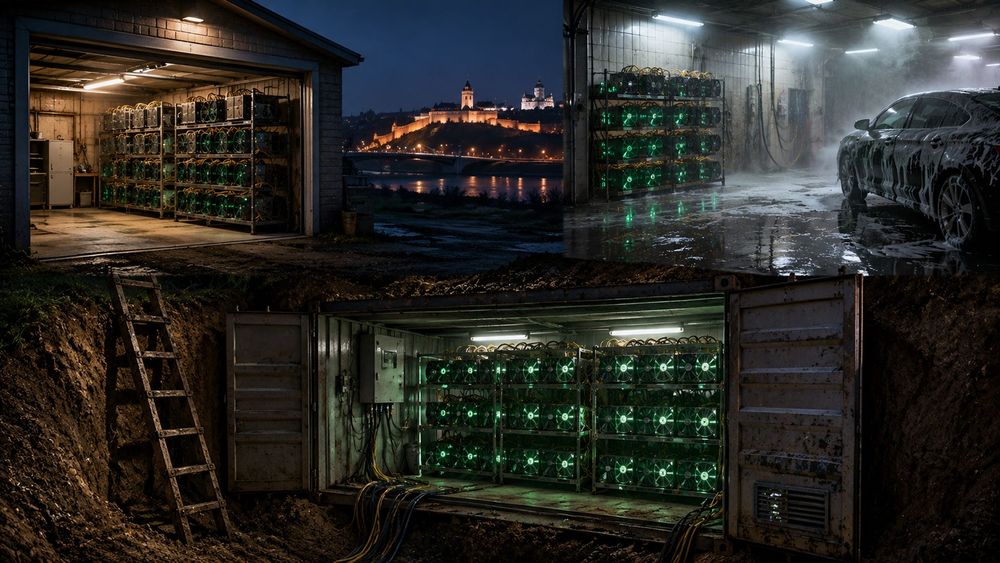
A Garage, a Car Wash and a Buried Shipping Container: Inside a Nine-Site Underground Mining Network in Nizhny Novgorod
Russia's transport police have disclosed a case that stands out from the usual run of illegal-mining reports. A 37-year-old entrepreneur from Nizhny Novgorod ran nine clandestine sites at once, and utility companies put the damage at close to 20 million rubles, roughly $250,000. The twist is that mining itself is entirely legal in the region. What drew the criminal case was not the activity - it was how the electricity was obtained.
What Investigators Actually Found
The starting point was a garage on the grounds of a transport company near the Pochinki railway station. The equipment there ran with no supply contract in place, and the electricity meter had been tampered with in a way that, in the police's phrasing, artificially understated the volume of power consumed.
It quickly turned out this was not a one-off. The same scheme was running at eight further addresses across Nizhny Novgorod. The sites were tucked into places where nobody expects to find industrial equipment:
- a garage on the grounds of a transport company;
- a car wash;
- the basements of residential buildings;
- a shipping container buried in the ground on a private plot of land.
In every case the grid connection was unauthorised and involved interference with the meters. The search yielded 120 mining devices, four mobile phones, a laptop and bank cards.
That last part of the list matters more than it appears. Phones, laptops and cards are not seized as a formality - they are how investigators connect the hardware to whoever ultimately collected the proceeds. Pools pay rewards to specific addresses, and converting those rewards into rubles almost always leaves a trail through bank accounts. That chain is what lets prosecutors argue all nine sites were run by one person rather than leased to independent operators.
Nine Addresses Instead of One: Why the Setup Looks Mature
A single garage full of hardware is a side hustle. Nine distributed sites is an operating model with deliberate risk management built in.
The logic behind splitting the load is straightforward. Three or four hundred kilowatts drawn at a single point produces an anomaly that a grid operator spots on the first imbalance analysis of that feeder. Spread across nine addresses, the same capacity reads as somewhat elevated consumption by several unrelated customers - taken individually, no single case stands out.
The second motive is resilience. Losing one site does not stop the other eight or zero out the revenue. This is why illegal miners rarely concentrate capacity: they think in terms of fault tolerance rather than ease of maintenance.
What a Mining Farm Is, in Plain Terms
A mining farm is a space filled with rows of purpose-built computing devices - ASICs - that work around the clock on a cryptographic problem for the right to write the next block to the blockchain and collect the reward in coins.
The key difference from an ordinary server room is the ratio between useful work and energy consumption. There is no idle state here: the hardware runs at 100% load for as long as power is applied. That dictates the economics. The only variable a miner can genuinely influence is the price of a kilowatt-hour. Everything else is set by the network.
Which is precisely why an unauthorised grid connection is not a minor infraction for this kind of business but the substance of the model itself. Zero out the dominant cost line and the operator gets a margin no legal competitor can reach.
How a Mining Farm Works - and Why It Is Hard to Hide
Technically it is simple: electricity in, hashes and heat out. The second output is every clandestine operator's core problem.
A modern ASIC draws somewhere around 3 to 3.5 kW. Practically all of that energy becomes heat - from a thermodynamic standpoint, the conversion into "useful" work is close to nil. One hundred and twenty machines means roughly 390 kW of continuous load and, correspondingly, about 390 kW of heat that has to be carried away without interruption.
For scale, that is comparable to heating a building of several thousand square metres. In a buried container there is physically nothing to dump that heat into - soil acts as insulation, not as a radiator. Hence the choice of locations: a car wash with existing water supply and a legitimately high electrical load, basements with air vents, a garage whose doors can be adapted for forced-air intake.
Then there is noise. A single unit puts out 75 to 85 dB, about what a vacuum cleaner sounds like up close. A dozen of them in a residential basement are audible on the floor above. Concealment here always runs into physics rather than tradecraft.
The Arithmetic of the Damage: Where 20 Million Rubles Comes From
The headline figure stays abstract until you break it down.
At a load of roughly 390 kW, monthly consumption lands near 280,000 kWh. At an average commercial tariff that works out to something like 1.5 to 1.7 million rubles a month. Divide 20 million by that and you get an approximate operating life for the network: about a year.
In other words, the utilities' estimate does not look inflated. It corresponds to roughly twelve months of continuous operation across all sites. It also explains how the case was charged: damage on that scale sits well past the threshold for the aggravated category.
Why 120 Machines Guarantees You Are Outside the Law
This is where the statutory framework matters. An individual in Russia may mine cryptocurrency without entering the Federal Tax Service register on one condition: monthly consumption must not exceed 6,000 kWh.
Now compare. A single modern ASIC running continuously consumes around 2,300 kWh a month. That means the individual allowance is exhausted by two or three machines. Not twenty, and not a hundred - two or three.
With 120 units there are exactly two options: register as a sole trader or legal entity and enter the mining register, or operate outside the law entirely. The legislation provides no intermediate state.
Why the Charge Is Article 165, Not Theft
Many people read stories like this as "he stole electricity" and wonder why there is no theft charge. The answer lies in the legal nature of the resource.
Under Russian criminal law, electricity is not a thing - it cannot be taken and appropriated the way a physical object can. The defining element of theft is therefore absent, which puts Article 158 of the Criminal Code out of reach. What applies instead is Article 165: causing property damage to an owner through deception or abuse of trust in the absence of the elements of theft.
The "deception" in this construction is precisely the meter tampering and unmetered consumption: the supply company fails to receive money it would have received under normal conditions. The injured party is not the subscriber but the grid or retail supply organisation.
The defendant is charged under Part 2 of Article 165. Under clause (b) of that part, covering especially large damage, the maximum sanction is five years' imprisonment. He remains under a travel-restriction order pending trial.
For comparison, in a similar matter the Magas District Court handed down three years and six months suspended, with a three-year probation period, on damage of roughly 2 million rubles. Here the sum is about an order of magnitude larger.
Mining Is Legal in Russia - So What Was the Violation?
This is the point that usually gets lost in news coverage. In Nizhny Novgorod and the surrounding region, cryptocurrency mining is not prohibited; the region does not appear on the restricted list.
The legal framework took shape back in 2024. Federal Law 221-FZ introduced definitions of mining and mining pools along with operator registers; Federal Law 418-FZ added taxation. Legal entities and sole traders must always be on the tax service's register, while individuals need to register only if they exceed the 6,000 kWh threshold.
So the charge is not about producing coins. It is about how the electricity was obtained. A legal operation in that same garage, with a supply contract and a working meter, would have interested neither the police nor the utilities.
Where Mining Is Actually Banned
From 1 January 2025 until 15 March 2031, a full prohibition applies in ten regions: Dagestan, Ingushetia, Kabardino-Balkaria, Karachay-Cherkessia, North Ossetia, Chechnya, the Donetsk and Lugansk People's Republics, and the Kherson and Zaporizhzhia regions.
Separately, seasonal restrictions apply during peak-consumption periods from 15 November to 15 March in Irkutsk Region, Buryatia and Zabaykalsky Krai. Analysts do not currently expect the list to expand in 2026 - there is no acute power deficit to justify it.
Nizhny Novgorod Region appears on neither list, which is what makes this case so instructive: the operator chose an illegal route in a place where the legal one was fully available.
What It Costs to Play by the Rules
The obvious follow-up question is how burdensome the legal alternative actually is. The answer is: considerably less than assumed.
Tax rates run as follows - 13 to 15% personal income tax for individuals, 6% or 15% for sole traders on the simplified regime, and 20% corporate profit tax for legal entities. Mined coins are recognised as income in kind at market value on the date of receipt, while electricity costs and equipment depreciation are deductible.
The practical gap between the legal and clandestine models comes down to the tariff. A lawful miner pays full price per kilowatt-hour and taxes on profit. An illegal one pays neither - and picks up a charge carrying up to five years. On damage of 20 million rubles, a year's worth of "savings" roughly equals the sum the grid company will claim in a civil action filed within the criminal case. Add seized hardware worth tens of millions more, and the scheme's balance sheet turns negative before any verdict is handed down.
How Utilities Track Down Underground Sites
The methods are well established and require no investigative luck.
Balance analysis. The grid operator compares energy dispatched into a given feeder against the total paid for by all customers on it. A persistent imbalance narrows the search area to a few streets.
Load profile. Residential consumption has pronounced daily peaks, morning and evening. A mining site produces a flat plateau with no overnight dip. On hourly metering data that shape is immediately obvious.
Thermal imaging. A winter drone survey reveals objects running hotter than their surroundings: melted snow on a garage roof, a warm patch above a buried container.
Reports from residents. Humming, vibration and unusual activity in a residential basement almost invariably reach the management company.
Meter inspection. Tampering leaves evidence - broken seals, altered wiring, discrepancies between readings and a control measurement at the service entrance. An instrumented inspection records this in a formal report, which then becomes the central piece of evidence.
One detail worth noting about the Nizhny Novgorod case: the initiative almost certainly came from the utilities rather than from detectives. Grid companies hold the hourly telemetry and are the first to see discrepancies, which is why most cases of this type begin with their referral rather than with intelligence work.
Why Garages, Basements and Car Washes
The set of hiding places here is not random and recurs across the country. A car wash offers high permitted capacity and water for cooling - a sharp consumption spike there does not look anomalous. A garage on industrial premises provides three-phase power and no neighbours. A residential basement is convenient for its proximity to the building's main distribution board. A buried container solves the problem of visual concealment, at the cost of making heat rejection almost impossible.
The general pattern: operators do not choose where it is safe, they choose where capacity has already been brought in. That dependence on existing infrastructure is exactly what makes such schemes fragile - you can hide the hardware from view, but not from the substation.
Not an Isolated Case
Comparable episodes are recorded regularly and across the map. Earlier, an illegal mining site was discovered in a treeline near the village of Stolbova in Irkutsk Region, after the power supply company flagged a suspicious grid connection to law enforcement.
The pattern repeats almost verbatim: the tip comes from the energy sector rather than from police work, because the people counting kilowatts are the first to see the anomaly. The Nizhny Novgorod case differs only in scale and in degree of organisation.
What Follows From This
Legalising the industry shifted the balance in a way many did not anticipate. Grey-market mining used to exist in a vacuum where the absence of rules functioned as permission. Now the rules exist - and against that backdrop, illegal setups have become more visible, not better protected.
Three practical conclusions follow:
- The individual allowance is not elastic. Beyond two or three machines, registration is mandatory. Appeals to "domestic scale" carry no weight.
- A supply contract is cheaper than a criminal record. The gap between a legal tariff and a custodial sentence is the gap between an expense line and a loss of liberty.
- Concealment runs into physics. Heat, noise and load profile cannot be disguised. Any sizeable operation eventually surfaces in the grid company's data.
Russian mining has already passed the point where operating illegally conferred an advantage. What it buys now is a delay - and as the Nizhny Novgorod case shows, that delay runs to roughly a year.
Worth noting who actually drove this discovery. Not surveillance, not neighbours' complaints, but routine analysis of consumption data: the numbers diverged before any external signs appeared. As metering migrates to smart devices reporting hourly, the window in which a clandestine site stays invisible will keep narrowing. Within a few years, hidden operation at this scale will be technically impossible long before anyone calls the police.
Is mining legal in Nizhny Novgorod Region?
Yes. The region appears neither on the full-prohibition list nor among the areas with seasonal restrictions. The criminal case was not opened over producing coins - it was opened over the unauthorised grid connection and the tampered electricity meters.
How many machines can an individual run without registering?
The limit is set in kilowatt-hours, not units: 6,000 kWh a month. A single modern ASIC consumes around 2,300 kWh, so the allowance is exhausted by two or three machines. Beyond that you must register as a sole trader or legal entity in the tax service's mining register.
Why is the charge Article 165 and not theft?
Under Russian criminal law electricity is not a thing - it cannot be taken and appropriated the way a physical object can, so the defining element of theft is absent. Article 165 applies instead: property damage caused through deception in the absence of the elements of theft. Part 2 carries up to five years.
Where is mining banned in Russia?
A full prohibition runs from 1 January 2025 to 15 March 2031 in ten regions: Dagestan, Ingushetia, Kabardino-Balkaria, Karachay-Cherkessia, North Ossetia, Chechnya, the Donetsk and Lugansk People's Republics, and the Kherson and Zaporizhzhia regions. Seasonal restrictions from 15 November to 15 March apply in Irkutsk Region, Buryatia and Zabaykalsky Krai.
How do utilities find underground mining sites?
Balance analysis across a feeder, load profile (a farm produces a flat plateau with no overnight dip), winter thermal-imaging drone surveys, reports from residents, and instrumented meter inspections. Most cases start with a referral from the grid company rather than with police intelligence work.
What does a legal miner pay?
13 to 15% personal income tax for individuals, 6% or 15% for sole traders on the simplified regime, and 20% corporate profit tax for legal entities. Mined coins are recognised as income in kind at market value on the date of receipt, while electricity costs and equipment depreciation are deductible.
Crypto mining is the process of validating transactions and adding them to the blockchain by solving complex mathematical puzzles using specialized hardware - and earning cryptocurrency rewards in return.
A mining pool is a group of cryptocurrency miners who combine their computing power to solve blocks more frequently, then share the rewards proportionally based on each miner's contribution.
Hashrate measures the total computational power used by miners to process and secure a proof-of-work blockchain network.
Crypto markets expert and head of content and marketing at EIDEX. Covers market structure, exchange infrastructure and cross-chain trading - turning on-chain data and market shifts into clear, actionable research for traders.