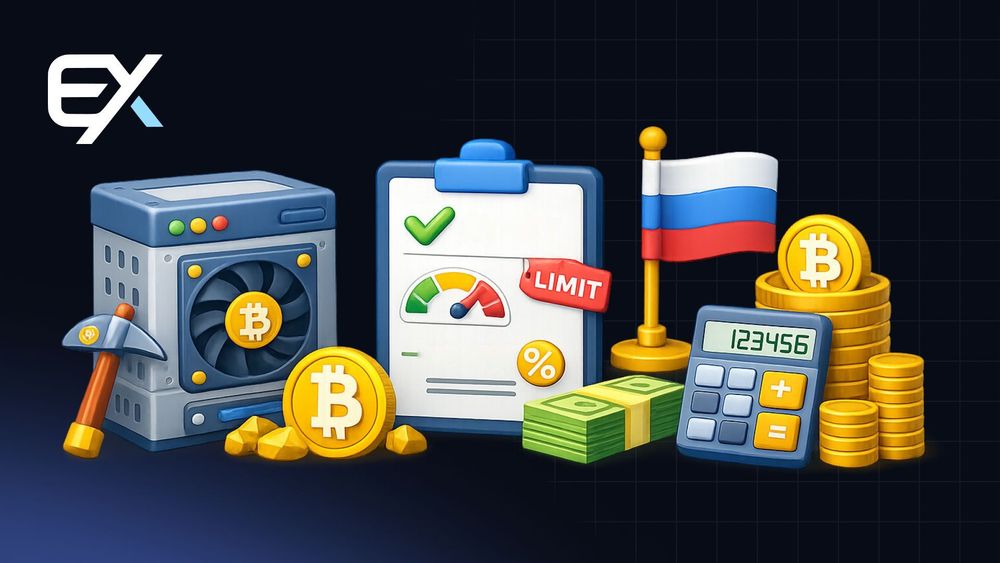
Crypto Mining in Russia 2026: Law, Limits and Taxes
The short answer on crypto mining in Russia: it is legal - digital-currency mining was legalized by Federal Law No. 221-FZ from November 1, 2024. Individuals without sole-proprietor status may mine within 6,000 kWh a month; companies and sole proprietors need an entry in the FNS mining registry (as of July 2026).
Last updated: July 25, 2026. Verified against Federal Law No. 221-FZ, the Russian Tax Code and official FNS publications. This material is for information purposes and is not legal advice.
Is Crypto Mining Legal in Russia - and Who Needs Registration
Yes - crypto mining in Russia has been a regulated activity since Federal Law No. 221-FZ took effect for mining on November 1, 2024. In legal terms, mining is the performance of computations that create digital currency; the law also defines mining pools and infrastructure operators and puts the industry under Federal Tax Service (FNS) oversight. The scale is already industrial: the Energy Ministry estimates that mining consumes about 16 billion kWh of electricity a year - roughly 2% of Russia's national demand (March 2026).
Mining for individuals without sole-proprietor (IP) status is freely allowed while power consumption stays within 6,000 kWh a month: no applications are needed - declaring the income is enough. Anything above the threshold, or run as a business, requires sole-proprietor or corporate status. For scale: modern ASIC units draw around 3 kW each, so 6,000 kWh is roughly two devices running around the clock - a home setup of one or two rigs usually stays inside the limit, an industrial rack does not.
Sole proprietors and organizations enter the FNS mining registry without exceptions. Mining is off-limits to people with unexpunged convictions for economic and grave offenses, and to those on the terrorist and extremist lists kept by Rosfinmonitoring; for companies the requirement extends to founders and beneficiaries.
| Mining mode | Requirements (as of July 2026) |
|---|---|
| Home mining, up to 6,000 kWh a month | No registration; declare the income; follow local restrictions |
| Sole proprietors and organizations | FNS registration, monthly reporting by the 20th, general taxation system |
| Hosting rigs with an infrastructure operator (a “mining hotel”) | The operator duplicates client data to the tax authority; taxes are paid by the hardware owner |
| Illegal mining above the limit | Additional tax assessments, fines, equipment seizure by court decision |
The FNS Mining Registry: Application and Monthly Reporting
The application is filed through the taxpayer's account on the FNS website - there is no state fee, and as of February 2026 the registry already lists more than 1,500 companies and sole proprietors (FNS data). The application covers:
- the equipment used for mining;
- the sites where it is installed;
- the connected capacity of each site.
Then a monthly duty kicks in: information on the received digital currency and the address identifiers is submitted by the 20th of the following month. Missing a report costs a RUB 40,000 fine under Article 129.16 of the Tax Code. Infrastructure operators file data on their clients in parallel, so industrial mining does not stay invisible to the tax authority. The entry can also be revoked: repeated reporting failures or mining in a banned territory are grounds for exclusion from the registry, after which continued extraction counts as illegal.
Taxes on Mining: Two Tax Bases and the Current Rates
The tax on mining runs through two bases, so a miner is assessed twice - but there is no double taxation:
- when the coins are received: income equals the market quote of the digital currency on the date it comes under the miner's control - the bitcoin (BTC) to ruble rate is the reference;
- when the mined coins are sold: the base is the proceeds minus the amount already taxed at the first stage and the costs of the deal.
Individuals pay personal income tax on a progressive scale starting at 13%, companies pay corporate profit tax at 25% on a separate tax base. Such operations are not subject to VAT, and special tax regimes - from the simplified system to self-employment - are closed to mining. The sums are becoming visible in official statistics too: the FNS put the potential tax bill of miners for 2025 at about RUB 567 million (spring 2026). Electricity and hardware costs are deductible for sole proprietors and companies on the general regime; an individual without IP status cannot reduce mining income by such expenses.
Calculation, deductible expenses and filing deadlines are covered separately in taxes on cryptocurrency and mining. Digital-currency turnover is overseen by the regulator: the crypto law effective from July 1 routes deals through licensed intermediaries.
Where Crypto Mining in Russia Is Banned: Regional Restrictions
By government decision, mining is fully closed until 2031 in ten regions - the North Caucasus republics (Dagestan, Ingushetia, Kabardino-Balkaria, Karachay-Cherkessia, North Ossetia and Chechnya) plus the DNR, LNR, Zaporozhye and Kherson regions - and, by a separate decision, in the south of Irkutsk Oblast. In Buryatia and Zabaykalsky Krai the work stops during peak-demand periods: in 2026 that is January 1 to March 15 (as of July 2026).
The list is not frozen: regional authorities may widen the restrictions, and the government reviews the geography as local grids come under strain. So the rules are worth checking for your exact address before switching the rigs on - a ban is tied to the territory where the equipment sits, not to the owner's place of registration.
Mining Hotels and Infrastructure Operators: Who Pays What
A mining hotel is an infrastructure operator's site - a data center that hosts clients' rigs, supplies power and cooling, and charges for the placement. Hosting the equipment there does not lift the obligations: the operator duplicates client data to the tax authority, but the taxes are paid by the hardware owner.
Before signing, the contract is worth checking on a few points:
- who owns the mined coins and how they are paid out;
- who is liable for downtime and at what rate;
- how physical access to the hardware is arranged;
- how the operator's reporting duties are separated from the client's.
The provider itself must be listed in the FNS register of infrastructure operators - working through an unlisted site leaves the client carrying the risks of illegal mining.
Penalties for Illegal Mining: What Grey Miners Risk in 2026
Today the sanctions stack up from three components: additional tax assessments with interest, the RUB 40,000 fine for unfiled data, and a power bill recalculated at the commercial tariff. Detection is routine: utilities report atypical loads, infrastructure sites report on their clients, and address transactions are matched against blockchain data.
The scale of the problem is measurable: according to Rosseti, “grey” miners caused about RUB 4.7 billion in damage in the regions in 2025 alone. That is exactly why liability is being tightened - a bill introducing a new Article 171.6 of the Criminal Code passed its first reading on May 27, 2026: fines up to RUB 2.5 million, confiscation of equipment and up to 5 years of imprisonment for organized groups or especially large income. The draft leaves an exit: a first-time offender who compensates the damage and pays double its amount to the federal budget is released from criminal liability.
Until the bill becomes law, illegal crypto mining in Russia is punished through administrative and tax mechanisms - but equipment seizure by court decision is already possible, and the direction of travel is unambiguous (as of July 2026). For home miners the practical takeaway is simpler: staying under the 6,000 kWh threshold and declaring the income keeps the setup fully legal - the tightening targets unregistered industrial farms.
_Disclaimer._ This article is for general information only and is not legal or tax advice. Regulation is still taking shape - a new liability bill is in parliament - so check the current rules and your region's restrictions before starting to mine.
Do I need sole-proprietor status to mine at home?
No, as long as consumption stays within 6,000 kWh a month. The single obligation is declaring the income. The status becomes necessary above the threshold or when mining is run as a business.
What happens if I exceed 6,000 kWh without registering?
The operation turns into illegal activity: personal income tax will be reassessed with interest, and the utility will recalculate the bill at the commercial tariff. As the new rules come into force, fines with confiscation of equipment will be added.
Can I mine in an apartment?
Legal home mining does not contradict the law if the threshold is respected. The real limits are household ones: load on the wiring, noise and heat, complaints from neighbors.
How does the tax office find out about a miner?
Through several channels: power companies report atypical loads, infrastructure sites report on their clients, and banks see regular incoming payments. Matching those flows is a matter of technique.
Is cloud mining legal in Russia?
There is no direct ban: the user buys capacity, while the work is done by the provider, which itself must be on the FNS list. Income from the digital currency is declared in the usual way. The main risk here is fraud - plenty of scam projects disguise themselves as cloud-mining contracts. Disclaimer. This article is for general information only and is not legal or tax advice. Regulation is still taking shape - a new liability bill is in parliament - so check the current rules and your region's restrictions before starting to mine.
Crypto markets expert and head of content and marketing at EIDEX. Covers market structure, exchange infrastructure and cross-chain trading - turning on-chain data and market shifts into clear, actionable research for traders.