
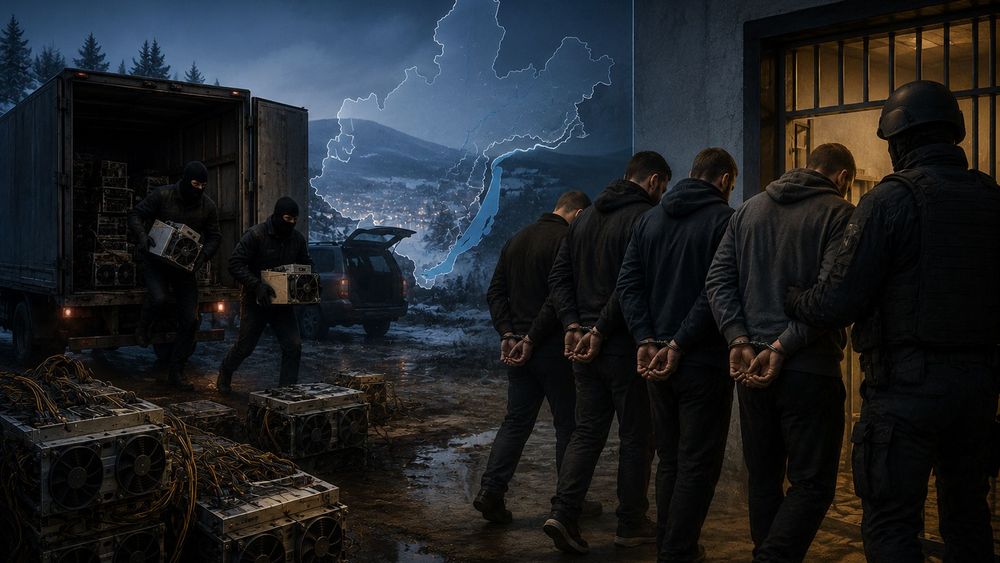
Four Sentenced in the Irkutsk Region for Stealing Mining Equipment Worth 5.3 Million Rubles
The robbery of a site in the Irkutsk region clearly showed that mining equipment has long become a coveted prize for criminals. The Kazachinsko-Lensky District Court found four residents of the settlement of Magistralny guilty of stealing 28 mining devices worth more than 5.3 million rubles. Law enforcement located the stolen goods and returned them to the owner, while the episode itself added to a growing list of crimes surrounding the mining industry in Russia.
Let us take a detailed look at how the theft was carried out, why mining hardware attracts thieves so strongly, and what site owners should know about the security of their operation.
What Happened: Details of the Nighttime Theft
The crime took place on the night of April 4-5, 2025. Four men entered the territory of an industrial base where unconnected mining equipment was stored in a warehouse. The haul was 28 devices for cryptocurrency mining - a substantial batch that investigators valued at more than 5.3 million rubles.
To avoid the lens of the surveillance cameras, the perpetrators wore masks. They acted with preparation: they had brought a truck in advance, on which they hauled the heavy mining equipment off the base's territory. By the standards of such thefts, this was a large and well-planned operation aimed precisely at expensive mining hardware.
How the Thieves Broke Into the Mining Site
The mining farm was located on an industrial site, but that did not stop the criminals. First they climbed over a concrete fence, then broke down the doors of a hangar where the mining equipment stood. It is impossible to carry out 28 devices alone, so an entire group worked on the theft, having assigned roles in advance.
The thieves did not leave the stolen hardware in place but began moving it between different storage points. At some point they abandoned the truck used in the theft in a forest near the village of Klyuchi. Such mobility is typical of crimes surrounding mining: the equipment is moved away from the site as quickly as possible before the loss is noticed.
The Stolen Mining Equipment Was Found and Returned
Police detained the four Siberians and tracked down the stolen goods. In the abandoned truck, officers found the property of the site - those very mining devices. One of the defendants actively cooperated with the investigation: he pointed out the storage location of the equipment and voluntarily handed the hardware over to law enforcement.
It was the cooperation of one of the participants that sped up the return of the valuable equipment to its rightful owner. This is a rare but telling case: more often, stolen mining hardware dissolves onto the secondary market, and recovering it is nearly impossible. Here, however, the entire array of equipment was found intact.
The Court Verdict: How the Case Ended
All four admitted their guilt. The Kazachinsko-Lensky District Court of the Irkutsk region handed them a sentence connected with the theft of expensive mining equipment. Given their cooperation with the investigation and the return of the stolen goods, the defendants got off with suspended sentences - a typical practice in such mining cases when the damage has been fully compensated.
The leniency of the sentence does not change the main point: a theft of almost five and a half million rubles showed how attractive a target mining equipment remains. For the mining market, this is yet another signal that a site's physical security is no less important than its profitability.
Why Mining Equipment Is Easy Prey
Mining hardware combines several qualities that criminals value. First, its high cost: a single modern ASIC for mining costs tens or even hundreds of thousands of rubles, so even a small batch runs into the millions. Second, its compactness and liquidity - mining devices are easy to transport and just as easy to sell.
Third, mining sites are often located in remote or poorly guarded places: hangars, industrial zones, out of town, closer to cheap electricity. Such placement, convenient for the operation, at the same time makes the object vulnerable. Finally, serial numbers are rarely tracked, which means stolen mining equipment is hard to identify after resale.
The Irkutsk Region as One of Russia's Mining Hubs
It is no accident that the Irkutsk region became the scene of such a theft. It is one of the country's key mining hubs thanks to cheap electricity from hydroelectric power plants. For years, both industrial and home cryptocurrency mining projects flowed here, and the density of sites is among the highest in the country.
The flip side of this concentration is a rise in the number of crimes surrounding mining. Where there is a lot of expensive hardware, there appear those who want to steal it. Besides thefts, the region has long been fighting illegal mining: underground farms steal electricity, and the damage to power companies runs into the millions. Here, mining equipment is both a target for thieves and the subject of constant police raids. Tellingly, it is in such energy-rich regions that the concentration of hardware is highest, and with it the risk of theft grows - criminals know perfectly well where to look for expensive devices and how to sell them off quickly afterward.
How Much Mining Equipment Costs
To grasp the scale of the loss, it is worth looking at prices. An average ASIC miner tuned for the SHA-256 algorithm costs a buyer anywhere from several tens to hundreds of thousands of rubles, depending on the model and hashrate. A batch of 28 mining devices is easy to value at the very 5.3 million rubles that appear in the case.
At the same time, the real value of a site is higher than the cost of the hardware itself. To it are added infrastructure costs: cooling systems, wiring, racks, and grid connection. That is why the theft of mining equipment hits the owner twice - they lose both the expensive hardware and their investment in organizing the entire process.
Legal vs. Illegal Mining: What Is the Difference
Since 2024-2025, mining in the country has gradually entered the legal framework. Legal mining involves registration, accounting of capacity, and honest payment for electricity at business rates. The state recognizes such mining and taxes it, and the equipment operates openly and legally.
Illegal mining consists of underground farms that steal electricity through unauthorized connections. According to expert estimates, the annual budget losses from such mining reach tens of billions of rubles, and the number of illegal miners runs into the hundreds of thousands. It is precisely gray mining that most often becomes both a victim and a source of thefts: equipment stolen at one farm frequently surfaces at another, underground site.
How to Protect a Mining Farm From Theft
The case in the Irkutsk region is a good reason to rethink the approach to mining security. The first rule is physical protection. Such a site must have a reliable fence, an alarm, and video surveillance, and better still - live guards, since masks, as the case showed, easily defeat cameras.
Second is hardware accounting. The owner should record the serial numbers of all mining devices, so that in the event of a theft the equipment can be identified and put on a wanted list. Third is insurance and access restriction: the fewer people who know exactly where the expensive hardware is stored, the lower the risk. Finally, it is wise to distribute the equipment across several locations so that a single theft does not bring down the entire mining business.
A Growing Problem: Thefts in the Mining Industry
The Irkutsk episode is not a one-off story but part of a trend. As mining turns into a serious industry, criminal interest in it also grows. Expensive mining equipment is stolen from warehouses, from hangars, and even from operating sites, and the stolen goods spread across the secondary mining market.
The problem is aggravated by the fact that the mining market largely remains opaque. Mining devices are easy to resell without documents, and buyers rarely check the origin of the hardware. Until the industry builds transparent equipment accounting, thefts like the one that happened in the Irkutsk region will keep recurring, and mining farms will remain a target. A separate difficulty is cross-border resale: stolen machines often move to neighboring regions or abroad, where they are almost impossible to trace. Law enforcement increasingly runs into organized groups that specialize precisely in hauling away expensive computing hardware and reselling it quickly.
What to Do If Your Mining Equipment Is Stolen
If a site is nonetheless robbed, you need to act quickly. Immediately contact the police and provide all the data on the stolen mining equipment: models, serial numbers, receipts, and photos. The more detailed the information, the higher the chance that the devices will be found, as happened in the Irkutsk case.
In parallel, it is worth alerting the community and the platforms through which such hardware is sold - sometimes stolen mining equipment surfaces in listings within a couple of days. And, of course, it is important to draw conclusions for the future: strengthen the site's security and rethink the organization of the entire operation so that a repeat theft becomes impossible.
How Industrial ASIC Miners Work
An ASIC miner is a specialized device created for a single task: to sift through billions of hashes per second. Unlike an ordinary computer, such a miner is not universal, but it is orders of magnitude more efficient. That is why large sites are assembled from hundreds of identical devices, arranged in dense racks inside hangars and data centers.
The key parameter of a device is its hashrate, that is, the speed of computation. The higher it is, the more coins the machine brings, but the more it costs and the more electricity it consumes. The 28 machines stolen in the Irkutsk region are precisely industrial ASIC miners, each of which represents real value on both the primary and the secondary market.
The secondary market for computing hardware is enormous. New ASIC miners are expensive, so many buyers hunt for used machines at a discount. This demand creates a convenient environment for offloading stolen goods: devices without documents change hands quickly and raise almost no questions among buyers.
That is precisely why thefts of computing power are so persistent. Criminals only need to haul the hardware off a site and list it on any trading platform under the guise of legitimate second-hand goods. Until buyers start massively checking the origin of hardware and its serial numbers, stolen machines will keep finding new owners within days.
The Experience of Other Siberian Regions
The Irkutsk case is far from the only one. All across Siberia, energy companies and law enforcement regularly bust underground crypto farms. For instance, the company Rosseti Sibir in a single season shut down seventeen illegal sites in Krasnoyarsk, Omsk, and Khakassia, and the total damage from electricity theft exceeded 60 million rubles.
The scale is striking: in Kuzbass, more than a hundred machines were counted at three underground sites, while in the Krasnoyarsk region a site with almost nine hundred devices, disguised as an apiary, was uncovered. The damage there was estimated in the hundreds of millions of rubles. Against this backdrop, the theft in the Irkutsk region looks like an ordinary but telling episode of the growing criminal activity around the sector.
Fines and Legal Regulation
The state is gradually tightening the rules. Since 2024-2025 the sector has entered the legal framework, and in the spring of 2026 a document appeared in the lower chamber's database on fines for mining digital assets in prohibited regions. Citizens face a fine of 100,000 to 150,000 rubles, officials up to 800,000, and companies up to 2 million rubles with confiscation of hardware.
Experts estimate the annual budget losses from illegal mining at almost 20 billion rubles, and the number of underground miners in the country runs into the hundreds of thousands. Regulation is meant to bring the sector out of the shadows, but for now the gray segment remains both the main consumer of stolen goods and its principal source.
Conclusion
The theft of 28 devices worth 5.3 million rubles in the Irkutsk region is a vivid illustration that mining today attracts not only investors but also criminals. Fortunately, this time the equipment was found and returned to the owner, and the culprits stood trial. But by no means does every story of stolen mining hardware end so happily.
The main takeaway is simple: when you engage in mining, you cannot underestimate physical security. Expensive equipment requires the same protection as any valuable asset, and competent site security can save millions. Nor should insurance be forgotten: a policy on expensive hardware can partly compensate the losses if preventing the theft still proves impossible. As the mining industry grows, a culture of security will become no less important for site owners than the profit itself.
What happened at the mining site in the Irkutsk region?
Four residents of the settlement of Magistralny stole 28 cryptocurrency mining devices worth more than 5.3 million rubles from an industrial base on the night of April 4-5, 2025. The equipment was later found and returned to its owner.
Was the stolen mining equipment recovered?
Yes. Police detained all four suspects and found the 28 devices in an abandoned truck. One of the defendants cooperated with the investigation and voluntarily handed the hardware over, which sped up its return to the owner.
Why is mining equipment such a frequent target for thieves?
ASIC miners are expensive, compact, and highly liquid; mining sites are often in remote or poorly guarded locations; and serial numbers are rarely tracked, so stolen hardware is easy to move and resell on the secondary market.
How can I protect a mining farm from theft?
Use physical security (a solid fence, alarm, cameras, and ideally live guards), record the serial numbers of every device, restrict who knows where the hardware is stored, insure the equipment, and spread it across several locations so one theft cannot wipe out the whole operation.
Crypto markets expert and head of content and marketing at EIDEX. Covers market structure, exchange infrastructure and cross-chain trading - turning on-chain data and market shifts into clear, actionable research for traders.