
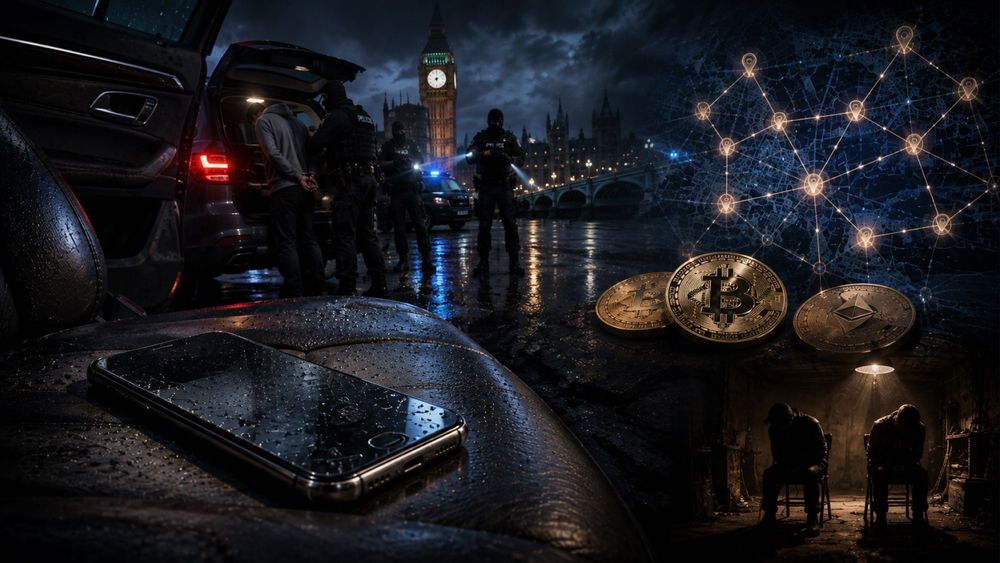
A Phone Left in the Car: How London Police Cracked a Crypto Millionaire Kidnapping
A jury at London's Central Criminal Court has found two men guilty of conspiracy to blackmail and false imprisonment. Three others were convicted of false imprisonment. Sentencing is expected in September, and custodial terms look all but certain.
The convictions were secured without testimony from the victims: both declined to appear in court, saying they feared the gang.
How the Two Frenchmen Were Taken
Two Frenchmen in their twenties had been staying in Kensington. It was their conspicuously lavish social media presence that drew the attention of the men who targeted them. During a trip outside the city they were ambushed by three masked assailants armed with a pistol and a knife, forced into their own car and driven to a flat in Canning Town.
The two were held there for 52 hours. They were starved, subjected to torture and threatened with violence against people close to them, with a demand of $150,000 in digital assets. The victims transferred $30,000, after which one was released and the other driven away to an unknown location - he later said he believed he had been sold on to a second gang.
The Phone That Cracked the Case
The break in the case came from something the kidnappers overlooked. A third passenger in the car was not taken and was simply pushed out of the vehicle, but his phone stayed inside unnoticed. He made his way to west London and persuaded a McDonald's security guard to call emergency services; the hideout was then traced through that phone's signal.
A sting followed. The girlfriend of one of the victims was kept in a rented flat, and when one of the kidnappers turned up seeking access to a further wallet, officers were waiting for him.
The operation was coordinated from abroad. The man investigators identify as the group's organiser, Ibrahim Mohamed, remains at large.
Torture-for-Ransom Attacks Are No Longer Isolated Incidents
CertiK counted 52 publicly known attacks on holders of digital assets in the first half of 2026 - up 33.3% on the same period in 2025, when there were 39 incidents. France accounted for the largest share, and this winter French authorities detained a tax office employee suspected of selling data on crypto millionaires to criminals.
Cryptocurrency here is not the motive but the instrument. An on-chain transfer is irreversible and requires no intermediary willing to unwind it, which is precisely what makes it convenient for a ransom, unlike a bank payment.
Two conclusions follow:
- a publicly identifiable crypto investor is a priority target, and displaying wealth on social media functions as an advertisement;
- discretion alone is not enough - the French case shows that an investor can come to a gang's attention through a leak from a state database, entirely outside their control.
What Actually Protects Against Coercion
The only defence that works is a technical one: an arrangement in which no single person is physically able to move the funds.
- multisig, with keys held by different people;
- a time delay on withdrawals.
What happened in London?
Two Frenchmen in their twenties were ambushed during a trip outside the city and held for 52 hours in a flat in Canning Town. The gang demanded $150,000 in digital assets and received $30,000. A jury has now convicted five men; sentencing is expected in September.
How was the case cracked?
A third passenger was pushed out of the car, but his phone stayed inside unnoticed. He reached west London and persuaded a McDonald's security guard to call emergency services, and the hideout was traced through that phone's signal.
Has everyone involved been caught?
No. The operation was coordinated from abroad, and the man investigators identify as the group's organiser, Ibrahim Mohamed, remains at large.
How common are attacks like this?
CertiK counted 52 publicly known attacks on holders of digital assets in the first half of 2026 - up 33.3% on the same period in 2025, when there were 39. France accounted for the largest share.
How can a holder protect against coercion?
Only technically: an arrangement in which no single person can move the funds - multisig with keys held by different people, or a time delay on withdrawals. Staying discreet on social media helps, but it does not protect against a leak from a state database.
Crypto markets expert and head of content and marketing at EIDEX. Covers market structure, exchange infrastructure and cross-chain trading - turning on-chain data and market shifts into clear, actionable research for traders.