How to Exchange Cryptocurrency for Rubles in 2026: Routes, Costs and Risks
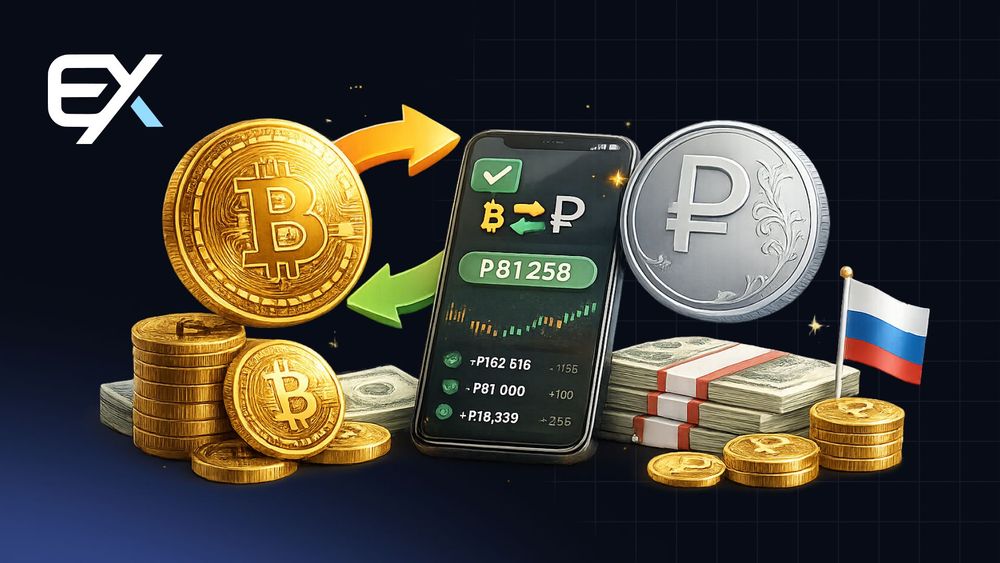
How to exchange crypto for rubles in 2026: sell the coins on an exchange, run a P2P deal, or use a crypto exchanger. The three routes differ in speed, costs and risk - from a blocked card to lost money. Below: a comparison, how to vet platforms, and the tax side of cashing out (as of July 2026).
Last updated: July 24, 2026. Verified against Federal Law No. 115-FZ, the Russian Criminal Code and official Bank of Russia publications. This material is for information purposes and is not financial advice.
How to Exchange Crypto for Rubles: Three Ways Compared
There is no single right route: to pick one, people compare limits, costs, platform document requirements and their own readiness to answer a bank’s questions about the origin of funds. The starting points are in the table.
| Method | Pros | Cons |
|---|---|---|
| Exchange: sell on spot and withdraw | Exchange price with no markup, transparent transaction history, high limits | Mandatory verification; ruble withdrawal often still runs through P2P mechanics or payment partners |
| P2P platform | Flexible payment methods, escrow holds the coins until confirmation, works for small amounts | The counterparty is a stranger: risk of fraud schemes, “dirty” incoming transfers and bank blocks |
| Crypto exchanger | Fast, many directions, including cash | Markup over the exchange price, scam sites exist, most are still outside the register |
The frame is set by the new law: exchanges, brokers and exchangers become licensed intermediaries listed in the Bank of Russia register, and from July 1, 2027, transactions outside this infrastructure lose legal protection - more in our overview of the crypto law effective from July 1. The scale at stake is real: the Bank of Russia estimates Russians’ balances on centralized foreign crypto exchanges at about RUB 720 billion (Financial Stability Review, spring 2026), while according to Chainalysis, users in Russia received about $376 billion in crypto between July 2024 and June 2025 - the largest volume in Europe. Any route is worth assessing against this rule (as of July 2026). Amounts, timing and platform requirements differ everywhere, so the table is a starting point, not a verdict - each route in detail below.
How P2P Crypto Exchange Works for USDT and Other Coins
P2P is a deal directly between users, with the platform acting as guarantor. One participant posts an ad with a price and payment methods; the other responds.
Step-by-Step Mechanics of a Deal
The scheme is the same on every platform (as of July 2026):
- The platform freezes the seller’s coins in escrow - until the deal is complete, neither side can touch them.
- The buyer sends rubles directly to the seller: to a card, via SBP (Russia’s fast payments system) or another agreed method.
- The seller confirms receiving the money, and the coins leave escrow for the buyer.
- In a dispute, the platform’s arbitration steps in and reviews logs, receipts and chat history.
Prices in the ads always differ slightly from the exchange quote: authors build the platform’s fee and their own margin into them. The bigger the amount and the more exotic the payment method, the wider the gap. Before you exchange crypto for rubles on the first ad you see, scroll through several offers and check the seller’s completion rate - reliable participants sit close to 100%, with enough crypto on the account for an instant release.
This kind of P2P crypto exchange removes the middleman with a cash desk: unlike an exchanger, you assess the counterparty yourself. Most often the method is used to withdraw USDT to rubles: the stablecoin is pegged to the dollar, so the price barely moves during a deal. Built-in exchange sections - for example, the EIDEX P2P section - use escrow by default and provide internal arbitration.
The payment window is limited and shown in the interface: miss it and the deal is cancelled with no loss to either side, with the coins staying in escrow until the money actually arrives. Limits are set by the ad’s author, from a few thousand rubles to millions. Large amounts are often split into a series of deals, but bear in mind: a string of incoming transfers from different people raises a bank’s questions faster than a single payment.
P2P Risks
The main fraud pattern is the “triangle”: the rubles come to you from the victim of a third-party scammer, the coins go to a third person, and it is the account holder who ends up explaining things to the bank and the police. The second risk is “dirty” incoming transfers: if the money arrives from a compromised account, the card gets blocked under Federal Law No. 115-FZ, Russia’s anti-money-laundering law, until things are cleared up. And remember irreversibility: once the coins are released from escrow, they cannot be recovered - the blockchain has no reverse gear. The third risk is money muling: since July 2025, handing your card to other people for a reward falls under Article 187 of the Criminal Code, and banks aggressively cut off operations that resemble it (as of July 2026).
Crypto Exchanger: How to Vet a Platform Before the Deal
An online exchanger is an intermediary with its own cash desk: it takes the coins and pays out rubles to a card, via SBP or in cash. It is faster than P2P, but the markup is heavier - and, crucially, a crypto exchanger is exactly what scammers most often disguise themselves as. Ten minutes of attention before sending money can save the whole deposit.
A minimum pre-deal check looks like this (as of July 2026):
- The Bank of Russia register. From summer 2026 this is the first filter: licensed intermediaries are entered into the register - under the adopted law, only Russian companies with at least RUB 15 million of own capital can run an exchanger - and legal monitoring services will work only with listed platforms. An exchanger with no clear legal status is a candidate for dismissal. While the register fills up, look for a public legal entity, AML rules and an offer agreement on the site.
- Monitoring aggregators. They bring together hundreds of crypto exchangers, showing declared reserves and complaints. Age is an argument too: fly-by-night sites rarely live longer than a couple of months. Real reserves mean the ability to pay the full amount at once; if an exchanger asks you to “wait for funds to arrive,” that is a warning sign.
- Ratings and reviews. Check scores on independent resources and in specialist chats, filtering out template praise written to a pattern.
- Scam markers. A price notably better than the exchange quote, a prepayment “to unblock the transfer,” extra charges after the request is created, a fresh domain cloning a known platform, no AML rules. If a service at any step demands money on top of the request, that is a fraud marker. A domain younger than six months and empty social accounts are two more reasons to close the tab.
The exchange request itself is simple: the user picks the direction, gets the payment details, sends the coins - and after network confirmations the exchanger pays out rubles. The price lock lasts a limited time, with the timer visible right in the request; if the transfer lands later, the exchanger recalculates at the current price. Cash exchange runs through “offices”: there it is worth separately making sure the meeting happens in a verifiable place and the money is counted in front of you. An exchanger seriously working with cash documents the payout.
Exchanger Risks
Clones of well-known crypto exchangers collect transfers and vanish; some platforms freeze payouts “for AML checks” with no deadline; cash deals in “offices” come with no guarantees at all. The bigger the amount, the more strictly the counterparty’s legal status deserves scrutiny.
Fees and Hidden Spreads: What the Cost of an Exchange Is Made Of
The total cost stacks up from three layers, and a noticeable part hides outside the fee schedule (as of July 2026):
- The platform’s fee. On exchanges it is a fraction of a percent per spot trade; on P2P it is usually paid by the ad’s author, who builds it into the price.
- The network fee. Moving coins between wallets is paid to the blockchain: sending USDT on TRC20 costs less than on ERC20, and a bitcoin (BTC) transfer costs more than stablecoins. Count the crypto withdrawal fee separately - the platform sets it, and the tariff changes from time to time.
- The spread. The gap between the exchange quote and the price in the ad or at the exchanger. This is the main “hidden” cost: the percentages in the fee schedule can be zero while the loss sits in the price.
Example: How Much the Spread Eats
You hand over 1,000 USDT. The exchange quote is RUB 80 per coin, so the reference is RUB 80,000. A P2P ad offers 79, an exchange point offers 77.5 plus a big “0%” in its tariffs. The outcome: RUB 79,000 versus RUB 77,500 - the whole loss hides in the spread, even though the second option is formally “cheaper.” The numbers are illustrative, the mechanics are real.
The practical rule: before you withdraw crypto to a card, compare the final amount you receive, not the percentages in the ads. The exchange quote is the reference - check it, for example, against the USDT to RUB rate widget, and the screener helps compare exchange routes by the amount you end up with. To exchange bitcoin for rubles without extra losses, factor in both the network fee and the spread from the start.
Deal Safety: Escrow, Arbitration and Common Scam Patterns
Escrow is the base protection: the crypto is locked by the platform until the buyer has paid, so a counterparty cannot “take and disappear.” Arbitration settles disputes from logs, receipts and chat history - keep all communication inside the platform, and store payment confirmations until the exchange completes and for several months after.
Common scam patterns look like this (as of July 2026):
- a fake receipt: the counterparty sends a forged payment confirmation and rushes you to “release the coins” while the money is “on its way”;
- a request to finish the deal off-platform - “faster and cheaper that way”: outside escrow, getting anything back is nearly impossible;
- a transfer to a “safe account” after a call from “support” - classic social engineering;
- phishing copies of popular platforms: a fake exchanger with a request form and swapped payment details looks identical to the real one.
A Short Pre-Deal Checklist
- the recipient’s payment details match the verified name on the platform;
- only your own card is used: someone else’s is the road to a money-muling charge;
- chats, receipts and files stay inside the platform, not in a messenger;
- for a large amount, it is sensible to start with a small test transfer.
A separate block is the relationship with the bank. A block under 115-FZ is not a criminal case: the bank pauses operations and requests documents on the origin of funds. Platform statements, deal history and income declared on time all help. Incoming payments from a register-listed intermediary look clearer to a bank than dozens of transfers from unknown individuals. And never accept other people’s transfers to your card “for a percentage” - the scale of the problem is exactly why the law was tightened: according to Bank of Russia estimates, about RUB 27.5 billion was funneled through money mules in 2024, and since July 2025 the money-mule amendments to Article 187 of the Criminal Code carry up to six years of imprisonment (as of July 2026). The regulator’s database of suspected money mules already counts about 1.2 million people, with roughly 100 thousand new suspicious accounts flagged every month (Bank of Russia data, autumn 2025).
The Tax Trail: What to Remember After the Exchange
The final part of any exchange is reporting. Moving coins between your own wallets does not count as income: what needs recording and documenting are the deals where rubles or another asset appear. Selling coins for rubles - and even swapping one asset for another - is taxable income: residents pay 13-15%, the 3-NDFL return is filed by April 30 of the following year, and banks see the ruble side of the chain. If exchange volumes are regular and visible, the bank may ask for explanations even with clean reporting - a document pack collected in advance turns that conversation into a formality. Keep not only bank statements but also screenshots of ads, receipts and chat history: such a pack closes most of the tax office’s questions. A detailed breakdown of rates, base calculation and fines is in the article on crypto tax in Russia in 2026.
To close, three rules of careful exchange: work with platforms that have a clear legal status, keep documents for every deal, and count the costs before the transfer, not after. It is duller than loud promises, but the money reaches the account (as of July 2026).
_Disclaimer._ This article is an overview of methods and risks, for general information only; it is not financial, legal or tax advice and not a recommendation of any specific platform. Rules are changing as the new law takes effect, so check a platform’s current status before any deal.
- Pick your exchange route
Compare the three ways: selling on an exchange (market price, no markup), a P2P deal with escrow, or a crypto exchanger (fast but with a markup). Weigh limits, costs and document requirements.
- Vet the platform before the deal
Check the Bank of Russia register, monitoring aggregators and independent reviews. Scam markers: a price notably better than the exchange quote, prepayments, extra charges after the request, a fresh domain.
- Calculate the amount you receive
Add up the platform's fee, the network fee (USDT on TRC20 is cheaper than ERC20) and the spread. Compare the final amount you get, not the percentages in the ads.
- Run the deal through escrow
The platform freezes the coins in escrow while the buyer sends rubles to a card or via SBP. Confirm the deal only after the money has actually arrived.
- Follow the safety checklist
The recipient's payment details must match the verified name, use only your own card, keep all chats and receipts inside the platform. For a large amount, start with a small test transfer.
- Keep records for taxes
Selling crypto for rubles is taxable income: residents pay 13-15%, the 3-NDFL return is due by April 30 of the following year. Store bank statements, receipts and screenshots of the deals.
Is it legal to exchange cryptocurrency for rubles in 2026?
Yes, you can exchange cryptocurrency for rubles legally: owning, buying and selling digital currency is allowed in Russia; only paying for goods and services with it is banned. The new law moves exchange operations to intermediaries from the Bank of Russia register, and crypto exchangers are gradually coming under licenses; deals outside this infrastructure lose legal protection from July 1, 2027 (as of July 2026).
What if the bank blocked my card after a P2P deal?
Don’t panic and answer the request: attach platform statements, transaction history and proof of the source of funds. A 115-FZ block is a procedure, not an accusation; the account is unblocked after explanations, usually within a few business days of a complete document pack. Hiding the crypto origin of the money is a bad idea - it worsens your position. If restrictions stay in place after the documents are in, a complaint via the Bank of Russia’s online reception usually speeds up the review.
How does an exchanger differ from a P2P platform?
An exchanger is a counterparty with its own cash desk: the price is fixed in the request, the markup is higher, but you don’t need to find a buyer and the exchanger itself pays out. On P2P you trade with another user directly, while the platform only holds the coins in escrow and settles disputes. Costs are lower, but assessing the counterparty is on you. For occasional small amounts P2P more often fits; for speed and cash - a platform with a cash desk; there is no universal answer.
Can I exchange crypto anonymously, without verification?
Crypto exchangers promising full anonymity exist, but they are exactly where most of the scam concentrates, and the bank sees the ruble side of the deal in any case. On top of that, operations outside the register infrastructure lose legal protection: there will be nowhere to argue about missing money. Anonymity here is a source of risk, not an advantage: the bank and the tax office don’t care whether the platform had verification.
How much is lost when withdrawing to a card?
There is no single figure: the exchange’s or exchanger’s fee, the network fee for moving the coins and the spread against the exchange quote all add up. Only the final amount you receive shows the real cost - compare it across several routes before the deal. _Disclaimer._ This article is an overview of methods and risks, for general information only; it is not financial, legal or tax advice and not a recommendation of any specific platform. Rules are changing as the new law takes effect, so check a platform’s current status before any deal.
Crypto markets expert and head of content and marketing at EIDEX. Covers market structure, exchange infrastructure and cross-chain trading - turning on-chain data and market shifts into clear, actionable research for traders.