"Everybody's Making Money": How the US President Explains His Crypto Billions
Combining the highest office in the country with a personal crypto business is a topic that surfaces ever more often in American politics. In a recent interview with CNBC, Donald Trump sought to fend off the accusations and explain why he considers his billion-dollar earnings from crypto projects entirely normal. Let us break down what exactly was said, what figures lie behind the controversy, and why the subject stirs such passion.
Trump's Argument: Crypto as a Race With China
Let us start with the substance of his remarks. Trump called cryptocurrencies a big business in which the United States is obliged to lead - otherwise, by his logic, China will seize dominance in the sector. It is precisely through the lens of global competition that he proposes viewing his own earnings: if crypto is becoming a strategic field, then the involvement of the country's top figures in it supposedly benefits the nation. The argument is framed so that personal interest looks like part of the national one: if the US does not take first place in digital finance, that place will go to others, and then the whole country loses, not just individual investors. Critics, however, note that the very same logic could justify almost any earnings of a top official. Tellingly, the image of the US as a leader of the digital economy runs constantly through the president's rhetoric - and each time it turns out to be a convenient backdrop for personal projects.
The Sum in Question: $1.4 Billion
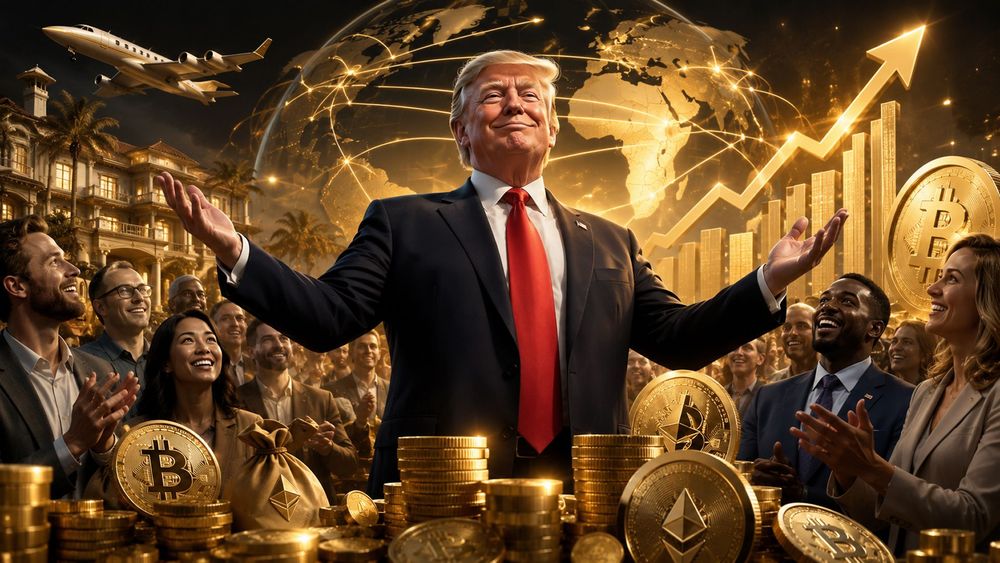
The key question of the interview concerned a specific sum. It was about the $1.4 billion that the president's family, according to journalists, received on the lending platform World Liberty Financial, as well as from the sale of WLFI tokens and the TRUMP memecoin. Asked directly about the ethics of such earnings, Trump replied that there was nothing wrong with it.
He backed up his position with a chronology. According to him, he began his crypto business before taking office, and therefore questions of a conflict of interest here are supposedly out of place. The logic is simple: if the venture was launched earlier, then today's profit is not an abuse of office but the continuation of a long-standing project. Opponents counter that the scale of the income rose sharply precisely after the move into the White House, which means the start date of the business changes little. The question is not when the project appeared, but whether the status of the country's top figure helps it today.
Who Manages the Assets and Is There a Conflict of Interest
There was also a separate claim about personal non-involvement. Trump assured that he does not take part in managing his investments directly - the assets, he claims, are handled on his behalf by large specialized companies. This arrangement is meant to dispel suspicions that the country's leader is manually "tweaking" the rules to line his own pockets. In practice, however, a formal transfer of management does not remove the conflict of interest: the beneficiary remains the official himself, which means he retains a motive to influence regulation in his favor. Lawyers note that in the US such arrangements have long sparked disputes even in relation to the ordinary business of presidents, let alone a field as volatile as crypto.
"Everybody's Making Money": Why the Comparison Fails
He expressed his idea as plainly as possible. Trump stated that he makes a profit because the stock market is rising, and in that situation all investors come out ahead. In other words, he presents his income not as something exceptional but as an ordinary result of a general market rally in which any holder of assets shares. The device is rhetorically strong: it dissolves personal gain into general prosperity and, as it were, puts the president on a par with millions of ordinary investors. The only problem is that an ordinary investor does not issue their own token and does not influence who will regulate this market or how. A rank-and-file shareholder can neither speed up approval of their own project, nor shape the makeup of the oversight body, nor steer the industry toward a course that suits them. The country's top figure has such levers by definition, and that is exactly why the comparison with an ordinary investor sounds nice but does not hold up to scrutiny. The difference is not in the size of the profit but in the amount of power behind it - and it is that power that turns a seemingly routine income into the subject of a major political dispute.
What Senator Warren Says
Yet by no means everyone in the country shares this view. Earlier, Democratic Senator Elizabeth Warren of Massachusetts publicly accused Trump of placing personal financial gain above the interests of the state. For the president's opponents, this has long been one of the main points of criticism. In the US, the overlap of power and business is traditionally a sore subject, and the appearance of a large crypto asset in the president's hands has sharpened it. Democrats saw it as a convenient target, while some Republicans preferred not to comment in order to avoid an awkward position. For US voters, the question is simple: is it acceptable for a person in the highest office to simultaneously earn money on a market whose rules he himself largely determines. There is no single answer in society, and the topic splits the audience roughly along the same lines as the rest of politics.
The senator's concerns are quite specific. Warren is troubled that Trump, in her view, could shield his own crypto projects from oversight by financial agencies - and thereby allow himself to earn a profit from cryptocurrencies while bypassing state control and without any accountability. This is essentially about the risk of building a zone for oneself that is inaccessible to regulators. If agencies subordinate to the executive branch turn a blind eye to the top figure's crypto projects, the ordinary rules of the market will cease to work the same way for everyone. It is precisely the equality of participants before the regulator that comes into question, not the fact of earning as such.
Why the SEC Softened Toward Crypto
Critics are further alarmed by a shift in the tone of the relevant regulator. The Securities and Exchange Commission has become noticeably more lenient toward the crypto industry, whereas previously it preferred to settle disputes with such companies through the courts. Many link this turn precisely to the new policy of the White House. Formally, the softening of the approach can be explained by the general US course of supporting innovation, but the timing, coinciding with the growth of the president's personal crypto projects, looks too conspicuous to ignore. Trump's supporters call it sensible liberalization; his opponents call it clearing the field for his own interests.
The Banking License as a Flashpoint
The matter has also reached concrete legislative initiatives. Back in February, Warren proposed denying a banking license to a crypto platform tied to the president's family - otherwise, the senator is convinced, it would amount to outright corruption. Thus the dispute moved from rhetoric into the realm of real decisions about licenses and powers. A banking license is no small thing: it gives a crypto platform access to the traditional financial infrastructure of the US and sharply increases client trust. That is why the question of whether the project tied to the president's family will obtain one has become genuinely pivotal.
How Trump Rates His Own Role in the Industry
Trump himself, however, assesses his role in the industry in the exact opposite way. He recently called his own memecoin bearing his name the "savior of the crypto industry," crediting himself with reviving interest in digital assets. Modesty in appraising his personal contribution is evidently not one of the leader's failings. Such framing is politically convenient: it turns a possible conflict of interest into a success story in which the president does not profit from his office but rather saves an entire industry. How well this picture matches reality is an open question, since the memecoin's surge rested largely on attention to the name itself rather than on the technology.
He builds his main argument around the image of the country. According to Trump, after his return to power the US turned into the world's crypto capital, drawing developers and crypto entrepreneurs once again. He portrays the previous administration as a brake, under which such an inflow of talent could only be dreamed of. There is a grain of truth to this: some crypto companies did complain about the harshness of the previous regulation in the US and moved to other jurisdictions. But attributing the industry's return solely to personal merit is a strong oversimplification, since market sentiment is shaped by many factors at once.
The Projects: World Liberty Financial, WLFI and the Memecoin
Here it is worth stepping back and examining which projects are actually being discussed. World Liberty Financial is a decentralized lending platform tied to the president's family. The WLFI token was issued within its ecosystem, while the memecoin bearing the leader's name became a separate, extremely volatile asset whose price soared and then sharply fell on the news. Memecoins by their nature have no fundamental value and live on hype, so tying such an instrument to the figure of the US president makes it especially sensitive to every public word. A single post can both enrich holders and leave them at a loss. Inexperienced investors who buy at the peak of the frenzy suffer especially often on such assets. US regulators have long warned of the risks of memecoins, but applying those warnings to a sitting president's project is far harder than to any other.
That is precisely why the question of income here is no idle one. When a figure of Trump's stature issues their own token, any word from them can move the market, while ordinary buyers risk ending up on the losing side of sharp swings. Critics point out that such a link between power and a personal asset creates obvious temptations. In an ordinary situation, the US regulator would watch such a project especially closely, but here the oversight bodies themselves depend on the executive branch. The result is a vicious circle in which those who appoint the review are the ones whose activity must be reviewed. It could be broken by an independent investigation or clear rules on a blind trust, but so far no such steps have followed. It is precisely the absence of an external arbiter that worries experts most: the system is forced to rely on the good faith of the beneficiary himself.
The Independence of Oversight in Question
The question of regulation is no less important. The country's crypto market still balances among various agencies, and far too much depends on who controls it and how. When the owner of a major crypto project is a person of Trump's stature, who influences the appointment of regulators, the independence of oversight is naturally called into question. In the US, oversight agencies are formally independent, but their leadership is appointed with the president's participation, and it is impossible to fully wall them off from politics. That is exactly why critics insist on additional guarantees of transparency.
It is worth acknowledging the other side of this argument as well. The thesis about competition with China does reflect a real process: the struggle for leadership in digital finance is being waged in earnest, and many countries are rushing to secure a technological advantage. In that sense, a bet on developing the industry looks rational - the only question is where the line runs between state interest and personal gain. The US is indeed interested in keeping key crypto technologies and capital inside the country rather than letting them flow to competitors. But the interest of the state and the wallet of a particular politician are not one and the same, and mixing them is dangerous even with the best of intentions.
The Bottom Line: A Stress Test for Institutions
So what is the upshot? Before us is a classic conflict with no simple solution. On one side is a politician's right to do business and a sincere conviction of the industry's benefit to the country. On the other is the risk that personal billions and state powers become too tightly intertwined, and that oversight weakens where it ought to strengthen. The story of the US president's income is, in essence, a stress test of the institutions themselves: whether they can treat an ordinary startup and a project backed by the country's top figure the same way. How this storyline resolves largely determines trust both in the crypto market and in US government agencies as a whole. The precedent will be telling regardless of how the specific story ends. If the institutions withstand the test and maintain an equal approach to all market participants, it will strengthen trust in the American model of regulation. But if it turns out that special rules apply to the top figure, the consequences will be felt by the entire industry - from major exchanges to ordinary coin holders.
While some see what is happening as normal entrepreneurial activity, others see an alarming precedent, in which the highest office and crypto capital end up in the same hands. This dispute is unlikely to die down soon: the sums are too large, the stakes too high, and the line between public duty and private interest too blurred. One thing is clear - the topic of crypto in high politics is only gaining momentum, and the next episodes of this story will not be long in coming. Most likely, the discussion will revolve around new licenses, bills, and further financial disclosures, and every fresh figure will once again raise the same uncomfortable question about the line between serving the country and looking after one's own capital. And the longer that line remains blurred, the louder the accusations will sound from both sides.
How much did the president's family earn on crypto?
The interview centered on $1.4 billion that the president's family, according to journalists, received on the lending platform World Liberty Financial, as well as from the sale of WLFI tokens and the TRUMP memecoin. Asked directly about the ethics of such earnings, Trump replied that there was nothing wrong with it.
How does Trump justify his crypto income?
He offers several arguments: crypto is a big business in which the US is obliged to lead, otherwise China will seize dominance; his crypto business began before he took office, so a conflict of interest is supposedly out of place; he does not manage the investments directly, since specialized companies handle them; and he profits simply because the market is rising, which benefits all investors.
What is Senator Elizabeth Warren's objection?
Warren publicly accused Trump of placing personal financial gain above the interests of the state. She is troubled that he could shield his own crypto projects from oversight by financial agencies and earn from crypto while bypassing state control. Back in February she proposed denying a banking license to a crypto platform tied to the president's family.
What are World Liberty Financial and WLFI?
World Liberty Financial is a decentralized lending platform tied to the president's family. The WLFI token was issued within its ecosystem, while the memecoin bearing the leader's name became a separate, extremely volatile asset whose price soared and then sharply fell on the news.
Why is this risky for ordinary investors?
Memecoins have no fundamental value and live on hype, so tying such an instrument to the figure of the US president makes it especially sensitive to every public word - a single post can both enrich holders and leave them at a loss. Inexperienced investors who buy at the peak of the frenzy suffer especially often, and applying regulators' warnings to a sitting president's project is far harder than to any other.
Crypto markets expert and head of content and marketing at EIDEX. Covers market structure, exchange infrastructure and cross-chain trading - turning on-chain data and market shifts into clear, actionable research for traders.