
NEAR Protocol (NEAR)
Trade NEAR on EIDEX with fees from 0.1%
Start TradingNEAR Protocol is a high-performance layer-1 blockchain designed to bring decentralized applications to a mainstream audience. Launched in 2020, it pairs sharding, sub-cent fees, and a developer-friendly environment with a strong focus on usability. The native NEAR token secures the network, pays transaction and storage fees, and powers on-chain governance. This page explains how NEAR works and how to buy NEAR on EIDEX.
Key Takeaways
- NEAR Protocol is a layer-1 proof-of-stake blockchain that uses Nightshade sharding to process transactions in parallel and keep fees near $0.001.
- The NEAR token has four core roles: paying fees, securing the network through staking, funding on-chain storage, and enabling governance.
- NEAR staking currently returns roughly 4–5% per year, with a minimum unbonding period of about three days.
- In October 2025, NEAR's maximum annual inflation was cut from 5% to 2.5%, while 70% of every transaction fee is permanently burned.
- You can buy NEAR with rubles on EIDEX through the P2P module, with trading fees from 0.1%.
What Is NEAR Protocol?
NEAR Protocol is a public, proof-of-stake blockchain built to make Web3 fast, affordable, and easy to use. It was designed as a scalable platform for application development, accessible to experienced engineers and newcomers alike. NEAR introduced human-readable account names — such as alice.near instead of long hexadecimal strings — a built-in account model, and an optimized environment for smart contract development.
The project's core goal is to hide blockchain complexity behind a familiar, Web2-style experience while remaining fully decentralized. In recent years, NEAR has positioned itself as an execution layer for AI applications, where autonomous agents can hold their own accounts and transact on a user's behalf. More detail is available in the official NEAR documentation.
Who Founded NEAR Protocol?
NEAR was founded by Illia Polosukhin and Alexander Skidanov. Polosukhin is a former Google engineer and one of the co-authors of the influential "Attention Is All You Need" research paper that introduced the Transformer architecture behind modern AI. Skidanov is a competitive-programming champion and a former engineering lead at the database company MemSQL. The non-profit NEAR Foundation supports the protocol's development and ecosystem funding, and the NEAR mainnet went live in April 2021.
How NEAR Protocol Works: Nightshade Sharding
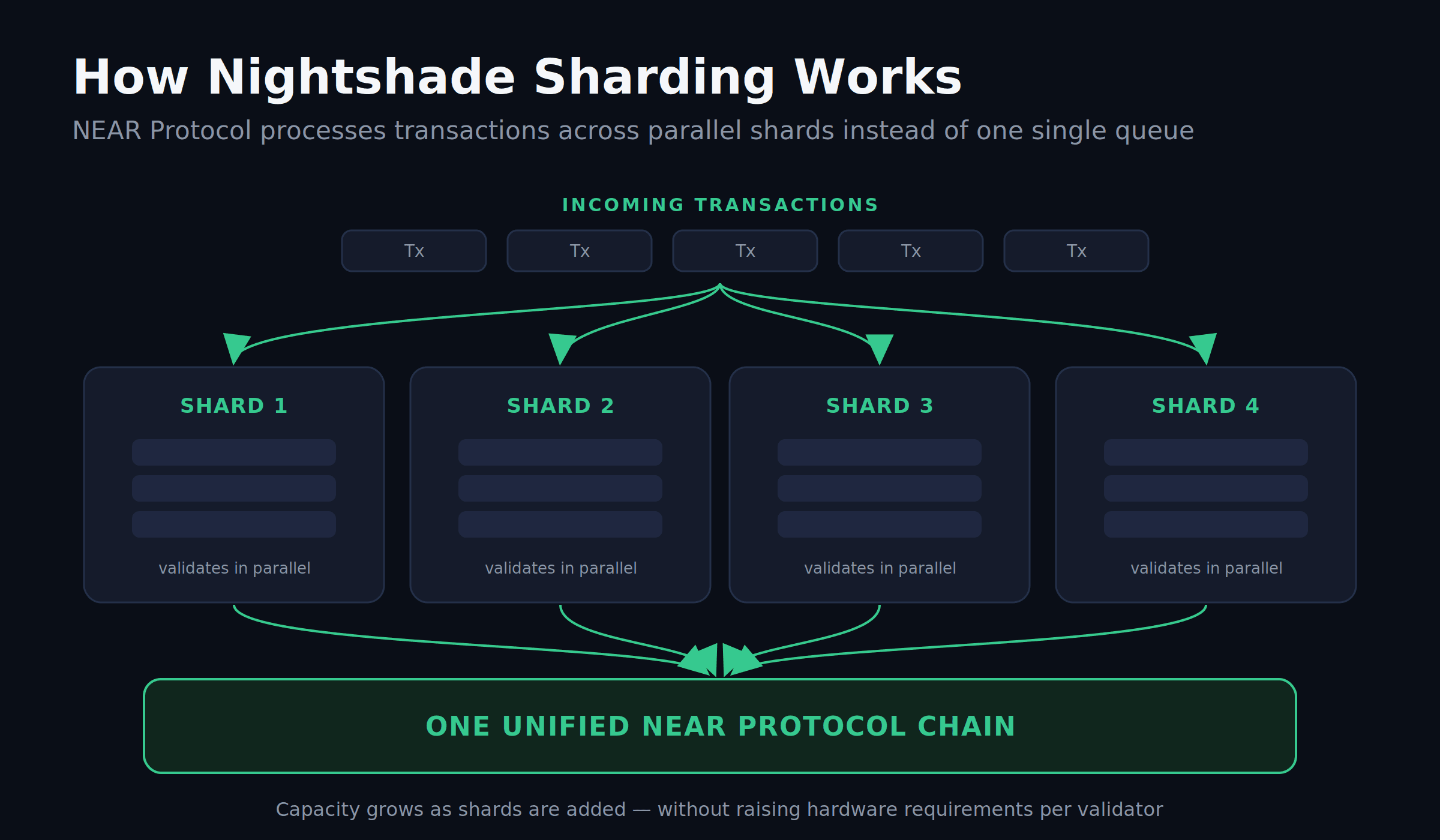
NEAR's scalability rests on Nightshade, the protocol's implementation of dynamic sharding. Rather than asking every node to process every transaction, Nightshade splits the network into parallel shards, each handling a portion of activity independently. The outputs are combined into a single chain, so users still experience NEAR as one unified network rather than a set of separate blockchains.
What Is Nightshade Sharding?
Sharding is a scaling technique that partitions a blockchain into smaller segments, called shards, that run in parallel. In NEAR's design, throughput grows with the number of shards: the network adds capacity by increasing shard count instead of raising hardware requirements for every validator. In a December 2025 benchmark, a sharded NEAR test environment reached over one million transactions per second across 70 shards.
Stateless Validation and Network Speed
The Nightshade 2.0 upgrade, rolled out across 2024 and 2025, introduced stateless validation. Stateless validation is a method where validators verify blocks using cryptographic proofs instead of storing the entire blockchain state, which lowers hardware costs and supports decentralization. NEAR secures this process with proof-of-stake consensus, as detailed in the Nightshade technical specification. After these upgrades, NEAR runs with block times around 600 milliseconds and transaction finality near 1.2 seconds, while standard transaction fees stay close to $0.001.
NEAR Smart Contracts and Developer Tools
NEAR supports a full smart contract environment through WebAssembly (Wasm). Rust is the primary contract language, while JavaScript SDKs lower the entry barrier for developers coming from Web2. Built-in testing tools, simulators, and project templates speed up prototyping and deployment.
This environment has made NEAR a foundation for hundreds of decentralized applications across several categories:
- DeFi: decentralized exchanges, lending markets, and liquid-staking protocols built on NEAR as the base asset.
- NFTs and gaming: marketplaces, digital collectibles, and on-chain game economies.
- AI agents: autonomous programs that hold NEAR accounts and execute transactions independently.
- Social and consumer apps: identity, payments, and chain-abstraction wallets aimed at mainstream users.
NEAR Staking and Validators Explained
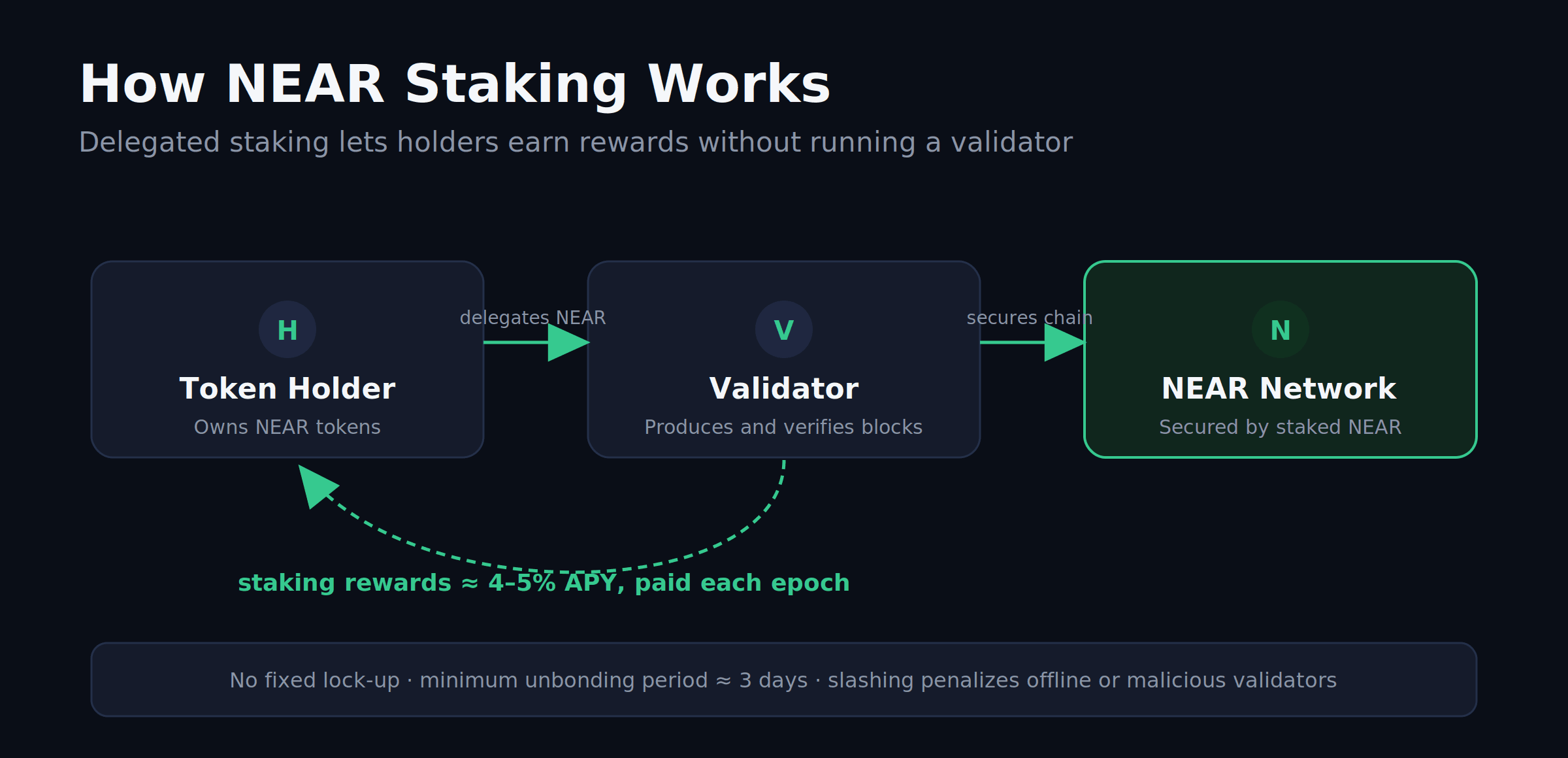
Network security on NEAR is maintained by validators. A validator is a node operator that processes transactions and produces blocks, selected according to the amount of NEAR staked to it rather than by computational power. Staking is the process of locking NEAR to help secure the network in exchange for rewards. Token holders who do not run their own validator can take part through delegated staking, assigning NEAR to a validator pool and sharing in its rewards.
How to Stake NEAR
- Choose a NEAR-compatible wallet or staking platform.
- Transfer NEAR tokens to your wallet.
- Review available validators by uptime, commission rate, and reputation.
- Delegate your NEAR to a chosen validator and confirm the transaction.
- Track rewards, which accrue automatically each epoch and can be compounded.
NEAR Staking Rewards and Risks
NEAR staking currently returns approximately 4–5% per year before validator commission, funded by protocol inflation and a share of transaction fees. Rewards have no fixed lock-up, but unstaked tokens pass through a minimum unbonding period of about three days before they become transferable. Validators that go offline or act maliciously can lose part of their stake through slashing, which strengthens overall network resilience. As of early 2026, more than 40% of circulating NEAR was staked.
NEAR Tokenomics: Supply, Inflation and Fees
NEAR launched with a genesis supply of one billion tokens at its April 2020 token event. The protocol has no hard cap; new NEAR is issued each year through inflation, with 90% of new issuance going to validators and delegators and 10% to the protocol treasury.
A landmark governance decision in October 2025 reduced NEAR's maximum annual inflation from 5% to 2.5%, lowering token dilution as network usage grows — a change documented in the NEAR Foundation's tokenomics update. Inflation is partially offset by fee burning: 70% of every transaction fee is permanently destroyed, while the remaining 30% is rebated to the smart contract involved — a distinctive incentive for developers to build on NEAR. When network activity is high enough, fee burns can outpace new issuance, making effective inflation negative.
What Is the NEAR Token Used For?
- Transaction fees: NEAR pays for computation and data on the network, typically near $0.001 per action.
- Staking and security: validators and delegators lock NEAR to secure the chain and earn rewards.
- Storage staking: accounts and contracts lock NEAR in proportion to the on-chain data they occupy.
- Governance: holders vote on protocol upgrades, inflation parameters, and treasury allocation.
NEAR Protocol vs Solana vs Ethereum
NEAR competes with other layer-1 platforms that target high throughput and low fees. The comparison below highlights how three leading networks differ on key dimensions.
Scaling approach: NEAR scales through dynamic sharding (Nightshade), Solana runs a single high-speed chain, and Ethereum relies on rollups and layer-2 networks.
Typical fee: NEAR transactions cost around $0.001, Solana fees are a fraction of a cent, and Ethereum fees are variable and often higher, especially during peak demand.
Consensus: All three operate on proof-of-stake.
Main focus: NEAR emphasizes usability, chain abstraction, and AI applications; Solana prioritizes raw speed and a large DeFi ecosystem; Ethereum offers the broadest application base and the longest security track record.
In short, Solana prioritizes raw single-chain speed and currently hosts a larger DeFi ecosystem, while Ethereum offers the broadest application base and the longest security track record. NEAR differentiates itself through dynamic sharding, human-readable accounts, and chain abstraction. Chain abstraction is a design that lets a single account operate across multiple blockchains without managing separate gas tokens or wallets.
How to Buy NEAR with Rubles on EIDEX
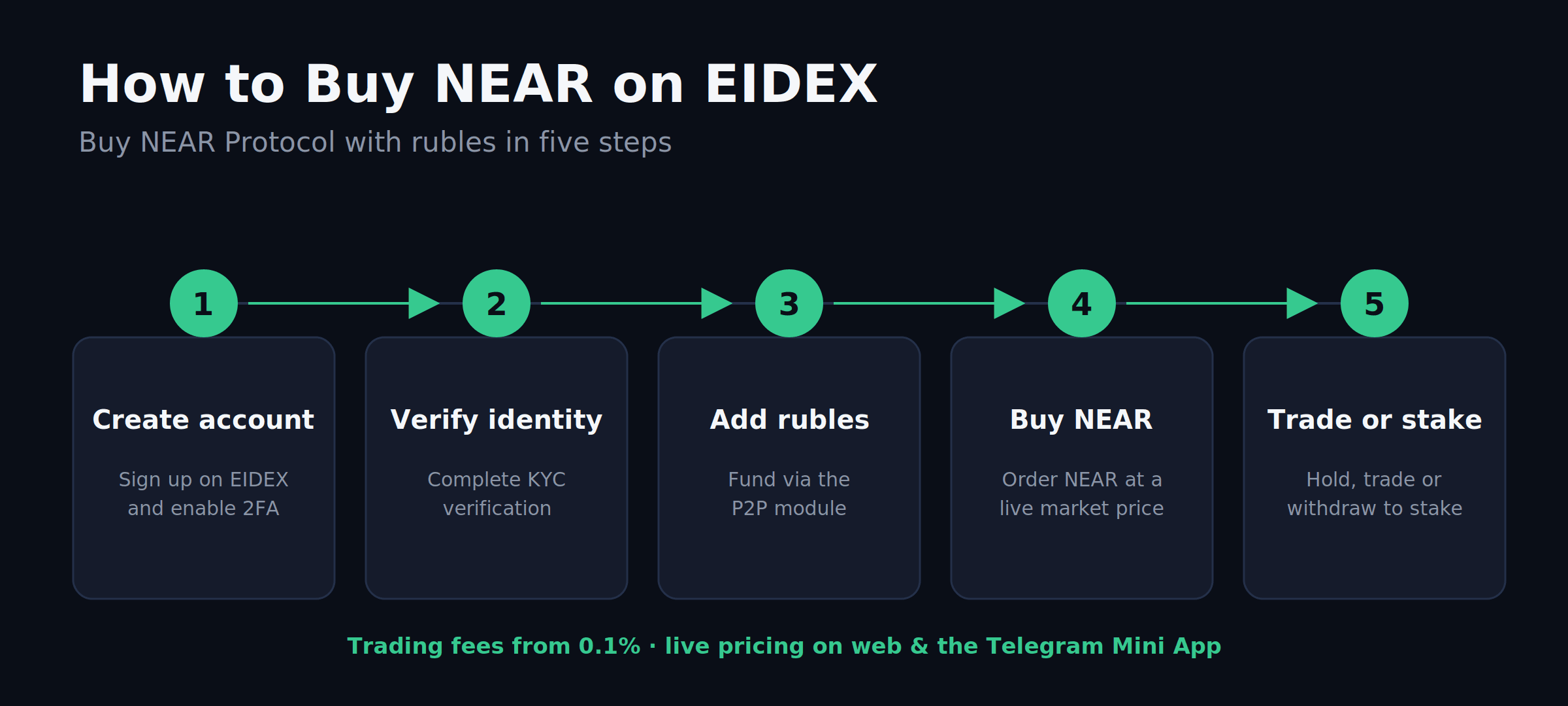
EIDEX makes it straightforward to buy NEAR Protocol with rubles. The process takes only a few minutes:
- Create an account on EIDEX and secure it with two-factor authentication.
- Complete identity verification (KYC) to unlock full trading and P2P access.
- Add funds in rubles through the P2P module, matched with verified counterparties.
- Buy NEAR at a live market price, or exchange it from another cryptocurrency.
- Trade or withdraw — keep NEAR on the exchange for active trading or move it to a wallet for staking.
EIDEX offers NEAR trading with fees from 0.1%, and live pricing updates across all trading pairs on both web and the Telegram Mini App.
NEAR Protocol Price and Market Data
The NEAR price reflects supply and demand across global markets and changes continuously. Key data points to follow include the live price, 24-hour trading volume, market capitalization, and circulating supply, which stood at roughly 1.29 billion NEAR in early 2026. The price widget at the top of this page shows current figures for NEAR and updates in real time. This page does not provide price forecasts.
Is NEAR Protocol a Good Investment? Risks and Outlook
NEAR Protocol's outlook is tied to the growth of Web3 applications, AI integration, and ongoing infrastructure upgrades. At the same time, every cryptocurrency carries real financial risk. The points below summarize both sides without offering investment advice.
Potential strengths:
- Scalable sharded architecture with low, predictable fees.
- Active developer ecosystem and a clear pivot toward AI applications.
- Reduced inflation and fee burning that can tighten effective supply.
Risks to consider:
- Price volatility typical of digital assets.
- Strong competition among layer-1 blockchains.
- Regulatory uncertainty across jurisdictions.
- Reliance on continued real-world adoption to sustain network activity.
Anyone considering NEAR should research thoroughly and invest only funds they can afford to lose.
What is NEAR Protocol?
NEAR Protocol is a layer-1 proof-of-stake blockchain that uses Nightshade sharding to process transactions in parallel. It is built for low fees, fast finality, and user-friendly decentralized applications.
How do I buy NEAR on EIDEX?
Create an EIDEX account, complete KYC verification, and add funds. You can then buy NEAR with rubles through the P2P module or exchange it from another cryptocurrency, with trading fees from 0.1%.
What is the NEAR token used for?
NEAR pays transaction and storage fees, secures the network through staking, and gives holders voting rights in on-chain governance. Developers also receive a rebate from the fees their contracts generate.
How does NEAR staking work?
NEAR uses delegated staking. Token holders assign NEAR to a validator and earn roughly 4–5% in annual rewards. Unstaked tokens pass through a minimum unbonding period of about three days.
What is Nightshade sharding?
Nightshade is NEAR's dynamic sharding system. It splits the network into parallel shards that each process part of the transaction load, allowing throughput to scale with the number of shards while keeping fees low.
How is NEAR different from Solana?
Both are high-performance proof-of-stake blockchains. NEAR scales by adding parallel shards and emphasizes chain abstraction and human-readable accounts, while Solana runs a single high-speed chain and currently hosts a larger DeFi ecosystem.
Does NEAR Protocol have a maximum supply?
No. NEAR has no hard cap. New tokens are issued through annual inflation, capped at 2.5% since October 2025, while 70% of transaction fees are burned, which can offset issuance during periods of high network activity.
Is NEAR Protocol a safe investment?
NEAR is a volatile digital asset with real financial risk. It has strong technology and an active ecosystem, but its value can fall sharply. Invest only what you can afford to lose.