
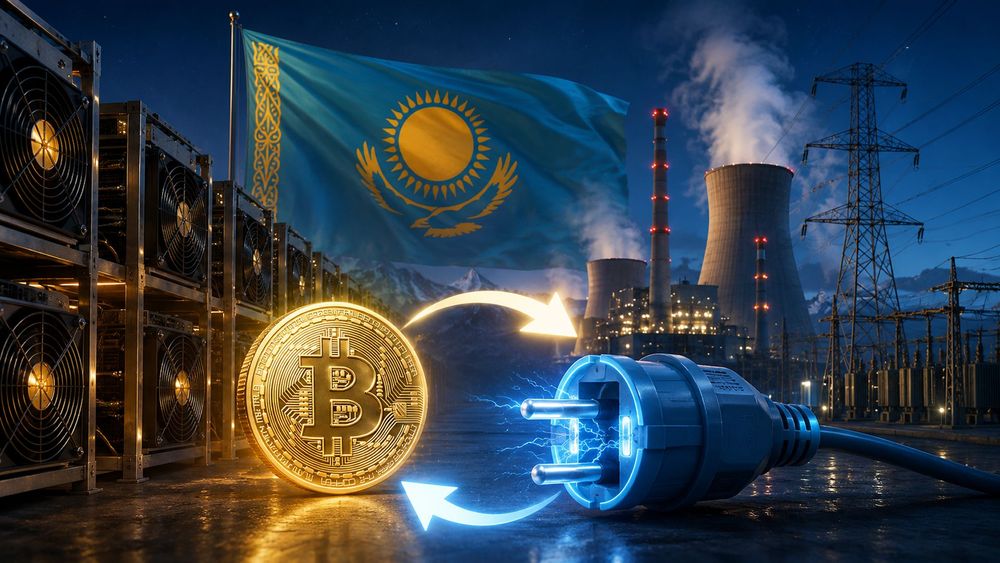
Bitcoin in Exchange for Cheap Power: Kazakhstan Launches "Strategic Mining"
The government of Kazakhstan has approved rules for "strategic digital mining." The scheme is simple: preferential access to electricity in exchange for a share of the mined coins, which will go into the state crypto reserve. The new rules take effect on August 1. In essence, bitcoin is becoming, for the first time, a form of payment for kilowatts.
How Much the State Will Take
Contributions to the state reserve will amount to 10% of all mined coins, minus the cost of the electricity consumed. In effect, bitcoin produced using subsidized power partly becomes the property of the country. The higher bitcoin trades on the market, the more valuable that share is for the treasury.
Power at a Capped Tariff
Electricity for the program will be supplied by the Ekibastuz GRES-1 power plant. The total quota is 300 MW, and it has been promised for a full ten years. Miners will be able to buy energy directly from the plant at a price not exceeding the capped tariff.
Right now, crypto-mining companies source electricity from suppliers at their own discretion, so a fixed tariff is a weighty argument for handing over part of the output. For an energy-intensive industry, a predictable price is often more important than the current rate at which bitcoin trades.
A Separate Wallet for Settlements With the Budget
A participant in the program is required to open a separate crypto wallet: it is through this wallet that the mined funds are distributed. At the same time, a miner retains the right to hold any number of other wallets in parallel, where their own bitcoin stays.
Who Qualifies as a "Strategic Miner"
An applicant files a request with the authorized state body and must own a data center with a capacity of at least 150 MW. Technical conditions are required for connecting to power grids from substations rated 35 kV and above.
There is a separate requirement for the hardware: every unit of equipment must deliver no less than 150 TH/s. Outdated farms, where bitcoin is mined on older devices, will not qualify for the program.
Requirements for a Clean Business
A company must have no debts on taxes, fees, pension or social contributions, and its property must be free of pledges, seizures, or bans on sale.
In addition, at least two contracts with telecom operators are required, along with an in-house repair service center on the data center's premises and staff with certified qualifications.
What Is Known About the Crypto Reserve
Authorities first started discussing a state crypto reserve at the beginning of the year. At the time, National Bank head Timur Suleimenov said that part of it would consist of digital currency seized by law enforcement.
It later emerged that the reserve would not be a stockpile of digital assets: the state intended to invest in financial instruments only indirectly tied to crypto.
What This Changes
Now the approach has reversed: bitcoin will flow into the treasury directly from miners, rather than through seizures or exchange-traded products. The state is trading kilowatts for real coins, taking a share of the output without investing in equipment itself. No purchases on an exchange: bitcoin arrives straight from the farms.
For the industry, this is a trade-off: bitcoin partly goes to the state, but in return there is a predictable energy price for a decade ahead. The winners will be the large sites - for smaller players, the 150 MW threshold is out of reach.
What is Kazakhstan's "strategic mining" program?
The government of Kazakhstan has approved rules for "strategic digital mining": miners get preferential access to electricity in exchange for a share of the mined coins, which goes into the state crypto reserve. The new rules take effect on August 1 - in essence, bitcoin becomes a form of payment for kilowatts for the first time.
How much of the mined bitcoin does the state take?
Contributions to the state reserve amount to 10% of all mined coins, minus the cost of the electricity consumed. Bitcoin produced using subsidized power thus partly becomes the property of the country, and the higher bitcoin trades, the more valuable that share is for the treasury.
Where will the electricity come from and at what price?
Power will be supplied by the Ekibastuz GRES-1 plant: a total quota of 300 MW promised for a full ten years. Miners will buy energy directly from the plant at a price not exceeding the capped tariff - a predictable price for a decade is a weighty argument for an energy-intensive industry.
Who qualifies as a "strategic miner"?
An applicant must own a data center of at least 150 MW, have technical conditions for connecting to grids from substations rated 35 kV and above, and every unit of hardware must deliver no less than 150 TH/s. The company also needs a clean record: no tax or contribution debts, no pledges or seizures on property, at least two telecom contracts, an in-house repair center and certified staff.
What is Kazakhstan's state crypto reserve?
Authorities first discussed it at the beginning of the year: National Bank head Timur Suleimenov said part of it would consist of digital currency seized by law enforcement, and later the state planned to invest in instruments only indirectly tied to crypto. Now the approach has reversed - bitcoin will flow into the treasury directly from miners, without purchases on an exchange.
Crypto markets expert and head of content and marketing at EIDEX. Covers market structure, exchange infrastructure and cross-chain trading - turning on-chain data and market shifts into clear, actionable research for traders.