Crypto, QR Codes, and Dropper Cards: How the New In-Store Payment Scheme Works
T-Bank and the Bank of Russia have flagged an unusual method of settlement in retail: buyers pay for goods with cryptocurrency via QR codes at self-checkout counters. At first glance it looks like a convenient service, but behind it, according to the bankers, lies a tool for disguising suspicious operations and extending the "lifespan" of dropper bank cards. Let us break down how this scheme works, who benefits from it, and why cryptocurrency plays a key role in it.
What Scheme the Bankers Found
The new mechanism was described by Alexander Yaroshevsky, deputy director of T-Bank's compliance department. The Bank of Russia and Rosfinmonitoring confirmed that they are aware of the scheme and detected it earlier this year based on transaction monitoring. Formally, it all looks like an ordinary purchase paid for with cryptocurrency, but the bankers are convinced that the main goal here is not settlement but the concealment of shadow money flows.
The point is that cryptocurrency makes it possible to create the appearance of normal everyday activity on someone else's card. While some people simply want to pay for a purchase with cryptocurrency, others use this flow to hide suspicious transactions from bank compliance systems. That is exactly why the scheme came to the regulator's attention. It is also important that such mechanisms arise at the junction of two worlds - traditional banks and cryptocurrency. While one side conducts ruble transactions on cards, the other operates in digital coins, and it is precisely at this boundary that room for abuse appears. The scheme vividly shows how cryptocurrency seeps into everyday settlements bypassing official rules, while small sums passing through such chains of operations collectively form a noticeable shadow flow.
How It Works Step by Step
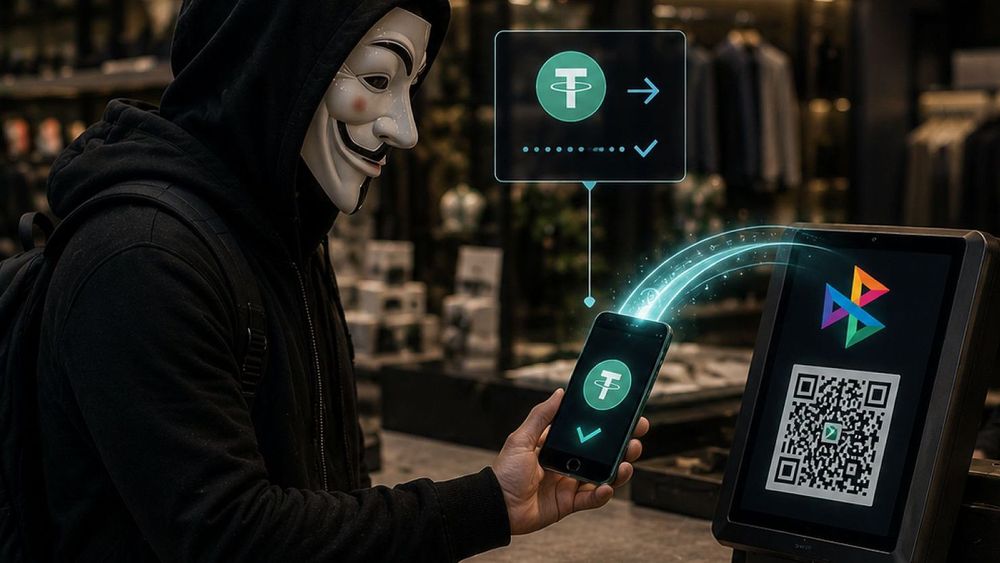
The mechanism is built on two parallel processes. The buyer holds the stablecoin USDT in a crypto wallet and, through a Telegram bot, initiates a purchase in an ordinary store. Instead of scanning the QR code with a banking app, they photograph it and upload it to the bot.
Next, the QR code is passed to a dropper, who pays for the purchase from their own bank card in rubles. At the same moment, crypto-assets are debited from the buyer's wallet, the equivalent of which is converted into rubles. As a result, the item is paid for, the store has received the money, and the cryptocurrency has traveled its path out of the cash register's sight. All the transactions look disparate, and linking them together is extremely difficult. The role of stablecoins is worth noting separately. Most often, USDT is used in such schemes - a cryptocurrency pegged to the dollar whose rate barely fluctuates. This stability makes the coin convenient for settlements: the buyer knows in advance how much cryptocurrency will be debited for a specific purchase, while high liquidity makes it possible to instantly convert it into rubles and complete the operation in a matter of seconds.
Why It Is Needed: "Warming Up" Dropper Cards
The key motive of the scheme, the bankers believe, is not the settlement in cryptocurrency itself but the creation of additional payment activity on droppers' cards. In specialists' jargon this is called "warming up" a card - accumulating a history of ordinary everyday operations: purchases in stores, cafes, payments for services.
Such transactions resemble the behavior of an average client, so suspicious operations dissolve in the general flow. This complicates the work of banks' monitoring systems and extends the lifespan of cards used in dubious schemes. In essence, cryptocurrency here acts as a convenient "fuel" for legitimizing activity rather than as the goal of the settlement.
Why the Store Notices Nothing
For the retail outlet, such an operation is indistinguishable from an ordinary transaction paid for by an individual via QR code. The store does not accept cryptocurrency directly and does not understand at all that a digital asset was involved in the chain of transactions. It simply receives rubles in the usual way - through QR and the Faster Payments System.
This is where the main difficulty lies. Banks cannot directly match the data of the cryptocurrency seller with an ordinary payment in a store. The only available method is analyzing the geolocation of the retail outlets and of the person whose card is used for payment, but for online payments it does not work.
The "Triangle" Scheme and Online Casinos
Experts compare such a settlement via a photographed QR code with the fraudulent "triangle" scheme. In it, a victim appears between the cryptocurrency buyer and the seller, one who is used blindly: the person is given details to pay for one purchase, although the payment actually serves another deal.
Another reason for the scheme's spread is the increased control over transfers between individuals' cards. According to experts' estimates, such a mechanism may be used to pay for bets in illegal online casinos. Whereas a player previously transferred money directly to a dropper's card, now they pay the QR code of someone else's purchase, and the equivalent is credited to the casino account. It is also beneficial to the cryptocurrency seller: they avoid an exchange through a crypto exchange, which carries the risk of receiving "dirty" rubles and falling under a block.
What the Risks Are and Why the Scheme Is Hard to Detect
The bankers do not yet call the practice widespread. In their assessment, this is more of a new processing technology than an independent cash-out scheme. Nevertheless, the regulator is monitoring the trend, since payment in cryptocurrency via QR code is used not only in retail.
Detecting such operations is indeed not easy. As lawyers note, banks analyze not only the amount and frequency of transactions but also other behavior patterns: geolocation, devices, the repetition of product categories, and the time between operations. The more precise the monitoring model, the higher the chance of spotting an anomaly, but there is still no universal solution. A separate problem is the speed at which new schemes appear. As soon as banks learn to recognize one workaround, wrongdoers come up with the next. Regulators have to constantly chase the market, while ordinary clients have to stay vigilant and not trust overly tempting offers to pay with someone else's hands or to "help" a stranger with a purchase. For the ordinary user, this is a reason to keep caution in mind and not take part in dubious chains even for the sake of a favorable rate.
The Legal Status of Cryptocurrency in Russia
A separate nuance is legality. Formally, cryptocurrency in Russia is considered property, and using it as a means of payment for goods and services is prohibited. That is exactly why direct settlements in cryptocurrency are impossible, and workaround schemes appear with the conversion of digital currency into rubles through intermediaries.
The situation is further complicated by regulatory uncertainty: the State Duma postponed consideration of the bill on state regulation of cryptocurrency circulation. The Central Bank and the Finance Ministry had counted on passing the law by July, but the timeline slipped. As long as the rules are not finally set, gray schemes involving cryptocurrency will keep appearing. This uncertainty hits all market participants. Legal services are forced to operate in a gray zone, while users do not always understand where the lawful use of cryptocurrency ends and a violation begins. Clear rules would help separate honest operations from fraudulent schemes and make the circulation of digital assets more transparent for all sides. Until then, caution remains the best ally of any owner of digital assets, and attention to detail a reliable protection of funds.
What Cryptocurrency Is and How It Works
To understand the mechanics of the scheme, it is worth figuring out what cryptocurrency is in the first place. It is digital money that exists only in electronic form. Unlike rubles in a bank account, cryptocurrency is not issued by the state and is not stored in a single bank - all data about it is distributed across a network of thousands of computers.
Every cryptocurrency runs on top of a blockchain. A blockchain is a distributed ledger in which all transactions are recorded. This record cannot be forged unnoticed: copies are stored by a multitude of participants, and cryptography provides protection. That is precisely why cryptocurrency is considered resistant to forgery, though it remains a high-risk asset. It is worth understanding that cryptocurrency is not a single currency but thousands of different projects. There is bitcoin and ether, there are stablecoins like USDT, and there is a multitude of small coins. They are all united by a common principle: their issuance and circulation are governed not by a bank but by program code and a network of participants. For a beginner this may sound complicated, but in practice using cryptocurrency is no harder than a banking app - the only difference is that you yourself are responsible for the safety of your funds.
Blockchain, Transactions, and the Distributed Ledger
Let us take a closer look. When you send cryptocurrency, the transaction enters a common pool and waits for confirmation. The network checks that the sender has enough coins, after which the record is added to the blockchain. From that moment the transaction becomes part of the chain and can no longer be canceled.
Such an architecture makes transactions transparent and at the same time pseudonymous: the ledger shows the movement of coins between addresses but not the names of the owners. All transactions on the blockchain are open for verification, which is what allows analysts to track suspicious chains. At the same time, the speed and cost of a transaction depend on the specific network and its load. It is worth adding that transactions in different blockchains are structured differently. In some networks confirmation takes seconds, in others minutes. The number of transactions a network can process directly affects convenience: the higher the throughput, the cheaper and faster operations go through. Analysts track these transactions to detect suspicious activity and link addresses to each other, even if the owners' names remain hidden. It is precisely the openness of transactions that distinguishes a blockchain from closed banking systems: anyone can check the history of transfers, though the identity behind an address remains anonymous. This transparency helps analysts but does not always protect the ordinary user from being drawn into someone else's dubious chains.
How to Buy and Store Cryptocurrency
The most familiar way to buy cryptocurrency is to use a special platform. On an exchange you can swap rubles for coins and then withdraw them to a personal wallet. It is important for a beginner to choose a reliable service: both the security of funds and the convenience of operations depend on this.
Cryptocurrency is stored in wallets - software or hardware ones. A wallet does not physically contain the coins themselves; it stores the keys that give access to the records in the network. Besides classic cryptocurrencies, there are thousands of tokens - digital assets issued on top of other blockchains. Some are used for settlements, others for access to services or in trading cryptocurrencies on specialized platforms. There are also other ways to obtain cryptocurrency. Some users buy coins directly from other people via P2P, bypassing intermediaries. In any case, before you buy cryptocurrency, you should make sure the platform is reliable and understand exactly how your coins will be stored, since losing access to a wallet means losing all funds irrevocably. The variety of assets is staggering: tens of thousands of different assets are in circulation today. Some coins claim the role of digital gold, others serve specific applications, and still others exist merely as an experiment. It is wiser to start with large and proven assets and to look at exotic tokens only with experience.
Mining, Staking, and Other Ways to Earn
You can earn on cryptocurrency in different ways. The first path is investment: buying coins in the expectation that their value will rise. This is the simplest but also the riskiest option, since the rate of cryptocurrencies is extremely volatile.
The second path is mining cryptocurrencies, that is, maintaining the operation of the network in exchange for a reward. Mining requires expensive equipment and large energy costs, so it is not suitable for everyone. A more accessible alternative is staking: the owner locks their coins in the network and receives income for participating in its operation. Another factor important when choosing an asset is liquidity: the higher it is, the easier it is to buy and sell coins at a fair price. The choice of earning method depends on goals and budget. For long-term investments, buying and holding assets is suitable; for more active participation, staking or mining. Experienced investors often combine approaches, distributing funds across different cryptocurrencies. But any investment in cryptocurrency remains risky, and you should invest only the money you are prepared to lose without harm to yourself.
How to Choose a Reliable Service and Avoid the Scheme
Cryptocurrency is a powerful tool, but it is precisely because of its anonymity that it also attracts fraudsters. To avoid becoming part of a dubious scheme, it is important to follow basic security rules. Do not hand over your QR codes and details to outsiders, do not take part in chains where you are offered to "just pay for someone else's purchase," and do not chase a suspiciously favorable rate.
You should choose a platform for operations deliberately: look at reputation, transparency, and the presence of security measures. Legal services value trust and will not draw you into gray settlements. Remember: behind a seemingly harmless payment in cryptocurrency via QR code, someone else's illegal activity may be hidden, and responsibility risks falling even on an accidental participant.
Conclusion
The scheme of paying with cryptocurrency via QR codes is a clear example of how a convenient technology turns into a loophole for shadow circulation. Cryptocurrency in it is not so much a means of settlement as a way to disguise the movement of money and "warm up" droppers' cards. The bankers and the regulator have already taken the trend under control, but detecting such transactions is still difficult.
For the ordinary user, the takeaway is simple: understanding how cryptocurrency works is useful, but taking part in dubious schemes is dangerous. Get to grips with the blockchain, transactions, and the ledger, choose reliable platforms, and do not forget about security. Then cryptocurrency will remain a convenient tool rather than a source of problems with the law.
What is the crypto QR-code payment scheme that T-Bank and the Bank of Russia flagged?
Buyers pay for goods with cryptocurrency (usually the USDT stablecoin) via a QR code at self-checkouts. In reality a dropper pays in rubles from their own card, while crypto is debited from the buyer's wallet and converted into rubles. Bankers say the real goal is not the purchase but disguising suspicious money flows and "warming up" dropper cards.
What does "warming up" a dropper card mean?
It means building a history of ordinary everyday operations - purchases in stores and cafes, payments for services - so that suspicious transactions dissolve in the general flow. This complicates banks' monitoring systems and extends the lifespan of cards used in dubious schemes.
Why doesn't the store notice anything?
For the retailer the payment is indistinguishable from an ordinary purchase paid by an individual via QR code and the Faster Payments System. The store does not accept cryptocurrency directly and cannot see that a digital asset was part of the chain of transactions.
Is it legal to pay with cryptocurrency in Russia?
No. Cryptocurrency in Russia is considered property, and using it as a means of payment for goods and services is prohibited. That is exactly why direct settlements are impossible and workaround schemes appear, converting crypto into rubles through intermediaries.
How can an ordinary user avoid being drawn into such a scheme?
Do not hand your QR codes and details to outsiders, do not take part in chains where you are offered to "just pay for someone else's purchase," and do not chase a suspiciously favorable rate. Choose only reputable, transparent platforms - legitimate services will not draw you into gray settlements.
Crypto markets expert and head of content and marketing at EIDEX. Covers market structure, exchange infrastructure and cross-chain trading - turning on-chain data and market shifts into clear, actionable research for traders.