The Crypto Kiosk as the Point of No Return: Why Billions Flow Through It in the $11B Scam
Almost every crypto scam in the US starts online - with a fake bank alert, a cloned voice, a romance chat, or a "tech support" pop-up. But the final command is almost always the same, and by then it is quite physical: withdraw cash, find a crypto kiosk, scan a QR code, and don't hang up until the money is gone. It is precisely this last step that has turned crypto kiosks into a pressure point of American fraud.
How the Scheme Works
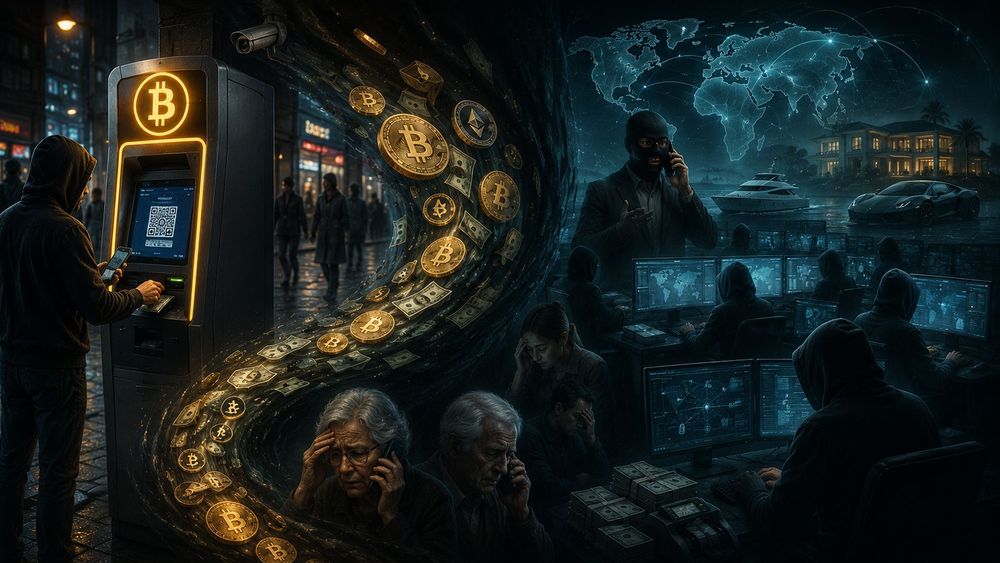
The logic is simple, and that is exactly what makes it so dangerous. The online deception creates the feeling that the money must be sent immediately, while a crypto kiosk offers a ready-made "payment gateway" that a frightened victim can use right in the shop around the corner, at a gas station, or in a supermarket. As the criminal dictates every step over the phone, the person feeds cash into the crypto kiosk and converts it into cryptocurrency.
As soon as the cash turns into cryptocurrency and goes to the scammer's wallet, the window for canceling the transfer closes. Unlike an ordinary ATM, where a transaction can still be disputed, an operation through a crypto kiosk is irreversible. In essence, the crypto kiosk becomes the last point where family, a bank, an operator, or a regulator can still intervene and stop the money. The scheme works like a conveyor belt: the online part prepares the victim psychologically, while the crypto kiosk serves as the cash register where fear is finally turned into money. The criminal deliberately keeps the person on the line until the very end - pressing, rushing, and giving no time to think or consult loved ones. The QR code plays a key role: it looks harmless, but embedded in it is the address of someone else's account. The victim points the camera, confirms the operation - and the purchased cryptocurrency goes straight to the scammer, bypassing the victim's own account. Such a transfer cannot be reversed: a blockchain does not know the phrase "disputed transaction."
The Numbers: $11 Billion and the Role of Crypto Kiosks
The scale of the problem is clear from FBI statistics. In 2025, Americans filed 181,565 complaints related to cryptocurrency, and the reported losses exceeded $11 billion. A separate IC3 report on crypto kiosks singled out a more specific mechanism: 13,460 complaints about crypto kiosks specifically and $388.9 million in adjusted damage in a single year.
The trend is alarming: the number of complaints about crypto kiosks rose by 23%, and losses jumped by 58% compared with 2024. Cryptocurrency became the "costliest" category of fraud in the entire report. The rise of generative AI has only sped up the process: fake profiles, voice clones, and deepfake videos drive the victim to a crypto kiosk already in a state of panic, ready to act on command. It is worth stressing separately that IC3 data cover only the cases victims actually reported. The real losses through crypto kiosks are almost certainly higher: many victims are ashamed to admit that they transferred their savings into cryptocurrency at a scammer's direction, and never file complaints at all. Even with this caveat, such machines have firmly established themselves as a recurring link in scams.
Warning Signs: How to Tell It's a Scam
The good news is that a crypto kiosk scheme can be recognized in advance - the warning signs are almost always on the surface. What should raise alarm is urgency and pressure over the phone, a demand to withdraw a large sum in cash and carry it specifically to a crypto kiosk, a QR code sent by someone, and a recipient address whose origin the person cannot explain. This also includes a request to split the payment across several machines.
If a bewildered person is standing next to a crypto kiosk, not letting go of their phone and clearly acting on someone else's instructions, this is the classic picture of a scam. The sooner the victim or a chance bystander notices these signs, the higher the chance of stopping the cryptocurrency transfer before the money finally goes to the fraudster's account. Common sense and basic security rules work better here than any "tech support."
Why the Scammer Doesn't Even Need to Touch the Crypto Kiosk
The most insidious part is that the criminal does not have to go anywhere near the device. He merely supplies the victim with detailed instructions: withdraw cash at the bank, walk to the crypto kiosk, deposit the money, and send it. For the user, a purchase through a crypto kiosk looks like a completely ordinary operation, but the address of the wallet the cryptocurrency goes to belongs to the scammer and is embedded in advance in that very QR code.
Often the wrongdoer asks the victim to break the sum into several parts or across several crypto kiosks to bypass daily limits and safeguards. All this time he keeps the person on the phone and does not let them come to their senses. That is precisely why a crypto kiosk is so convenient for the scheme: it turns fear into an irreversible cryptocurrency transfer faster than anyone can intervene. Technically it all looks mundane: the victim simply "buys cryptocurrency" at the crypto kiosk, like hundreds of ordinary customers before them. No hacking and no viruses - only social engineering and a single QR code leading to the criminal's account. This very simplicity is what makes such terminals so resilient a link in fraud schemes.
Who Suffers the Most
The blow falls first and foremost on the elderly. More than half of all complaints about crypto kiosks came from people over 50, and their combined losses exceeded $302 million. The reason is simple: this is exactly the audience that more often trusts a "call from the bank" and gets flustered at a crypto kiosk under pressure from a pushy stranger.
The situation is made worse by the fact that crypto kiosks stand in familiar places - where people already buy gas, groceries, and small items. Walking up to a crypto kiosk is psychologically easier than admitting a scam is underway. According to FTC data, losses at crypto ATMs grew nearly tenfold between 2020 and 2023, and the median loss per victim was about $10,000. What lets the elderly down is not naivety but deference to authority: when a "bank employee" or a "police officer" insists on acting, it is psychologically hard to refuse. And a crypto kiosk at hand instantly turns that trust into an irrecoverable loss.
Why the Fees Don't Scare the Criminals
At first glance, crypto kiosks seem uneconomical: their fees reach 7-20%. For an honest buyer of cryptocurrency this is frankly a bad deal. But for a scammer a high fee is part of the business model: the cryptocurrency leaves the victim's wallet instantly, and recovering it afterward is almost impossible.
That is why criminals calmly put up with the losses on a crypto kiosk fee. What interests them is not a favorable rate but speed and irreversibility: once the money has become cryptocurrency in the right wallet, the scheme has worked. The crypto kiosk in this chain is not an annoying line of expenses but a key working tool, the whole point of the operation. By comparison, a legitimate user will think three times before handing over a fifth of the sum for an exchange. The scammer, however, is not bothered by this fee - he is operating with someone else's money, and his only goal is to move the cryptocurrency out of the victim's account and beyond reach as quickly as possible.
The Last Chance to Stop the Transfer
That is precisely why the crypto kiosk has ended up at the center of the question of responsibility. It is the victim who presses the buttons, but before the transfer there are almost always visible warning signs: a large cash withdrawal, a nervous client, an endless phone call, someone else's QR code, and a wallet address the person cannot clearly explain.
While the money has not yet left, intervention is still possible. A teller who doubts a hurried cash withdrawal, an operator who blocks a suspicious operation at a crypto kiosk, a state limit, or a relative who recognizes the familiar script - any of them can change the outcome. After the transfer, the tools sharply weaken: the transaction is visible on the blockchain, but the cryptocurrency moves through wallets and exchanges faster than the victim even realizes the deception. This asymmetry is what makes the crypto kiosk so attractive to criminals: before the transfer the system has plenty of chances to step in, and afterward almost none. The bank servicing the crypto kiosk operator also bears its share of responsibility: it must understand whether the business has real measures against fraud and money laundering.
What the Authorities Are Doing and How to Protect Yourself
Regulators are gradually tightening the screws. In California, the digital financial assets law prohibits crypto kiosk operators from accepting more than $1,000 from a single person per day. In Florida, a new law has required operators to give warnings, issue receipts, impose limits, and even provide refunds in cases of fraud. FinCEN, in turn, requires banks to detect and report suspicious operations involving crypto kiosks, since it is precisely unscrupulous operators who most often become the loophole. Scammers deliberately send victims to specific machines, sometimes even in another state, to bypass stricter controls. There is no single federal standard yet - each state assembles its own set of measures: low daily limits, clear warnings on the crypto kiosk screen, live support, and the right to a refund. The point of all these measures is the same - to buy time in that very short interval between the cash withdrawal and the cryptocurrency transfer. The more barriers are built into the operation of a crypto kiosk, the higher the chance that the victim will stop and think. But as long as the rules differ from state to state, fraudsters will look for the weakest spots and steer victims exactly there.
For the ordinary user, the best protection is simple security rules. Remember: no real bank or government agency will demand that you urgently carry cash to a crypto kiosk. If a stranger on the phone rushes you to deposit money into a crypto kiosk and has sent you a QR code, it is almost certainly a scam. Do not transfer cryptocurrency to someone else's wallet under pressure, and do not be afraid to simply hang up. Basic digital security and a single pause can save all of your savings.
The Bottom Line
Crypto kiosks were conceived as a convenient bridge between cash and cryptocurrency, but in the hands of scammers they have turned into a final trap. A device that looks like an ordinary ATM has become the last link in the $11 billion scam - the place where fear turns into an irreversible transfer. Until operators, banks, and lawmakers make this moment safer, the crypto kiosk will remain the weakest link in crypto fraud. And the main protection here is the awareness of the user themselves and a healthy skepticism toward any call that drives you to a crypto kiosk with a wad of cash in hand. As long as the technical irreversibility of the blockchain is combined with human trustfulness, crypto kiosks will remain bait for fraudsters. But the very fact that almost any such scheme can be broken with a single call to loved ones or one short pause in front of the screen inspires cautious optimism. The main thing is to remember: haste always benefits only the scammer, not you. A couple of minutes to check and one sober question - "why is this so urgent?" - are worth more than any assurances from a stranger on the phone, whoever he claims to be.
What is a crypto kiosk (Bitcoin ATM) and why is it used in scams?
A crypto kiosk is a machine that turns cash into cryptocurrency. Scammers exploit it because once the cash becomes crypto and reaches their wallet, the transfer is irreversible: unlike an ordinary bank transaction, it cannot be disputed or reversed, so the kiosk is the last point where anyone can still intervene.
How does the crypto kiosk scam work?
The victim is first hooked online - a fake bank alert, a cloned voice, a romance chat or a "tech support" pop-up. Then they are pressured to withdraw cash, walk to a crypto kiosk and scan a QR code that secretly holds the scammer's wallet address. The criminal stays on the phone, rushing the victim until the money is gone.
How much are Americans losing to crypto scams?
In 2025 the FBI logged 181,565 crypto-related complaints and more than $11 billion in reported losses. A separate IC3 report counted 13,460 complaints about crypto kiosks specifically and $388.9 million in adjusted damage - a 23% rise in complaints and a 58% jump in losses versus 2024.
Who is most at risk from crypto kiosk fraud?
People over 50. More than half of all crypto-kiosk complaints came from this age group, with combined losses above $302 million. FTC data show losses at crypto ATMs grew nearly tenfold between 2020 and 2023, and the median loss per victim was around $10,000.
How can I protect myself from a crypto kiosk scam?
No real bank or government agency will ever demand that you rush cash to a crypto kiosk. If a stranger on the phone pressures you to deposit money and has sent you a QR code, it is almost certainly a scam. Do not send crypto to someone else's wallet under pressure - just hang up and take a short pause to check.
Crypto markets expert and head of content and marketing at EIDEX. Covers market structure, exchange infrastructure and cross-chain trading - turning on-chain data and market shifts into clear, actionable research for traders.