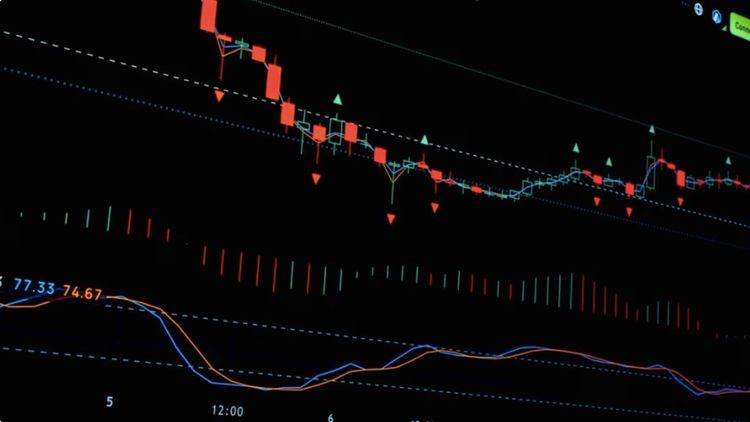

What Are Futures on a Crypto Exchange
This is the first question almost every new crypto exchange user starts with. In simple terms, a future is an agreement between two parties to buy or sell an asset at a predetermined price at some point in the future. On the crypto market, a future rarely results in physical delivery of the cryptocurrency: 99% of contracts are settled in cash, and the trader simply earns a profit or takes a loss on the difference between the entry and exit price of the future.
Crypto uses two main types of futures contracts. The first is a dated futures contract with a fixed expiration (for example, a quarterly BTCUSDT future expiring in March, June, September, or December). The second is perpetuals (perps), which have no expiration date and track the spot price through a funding rate mechanism. On major platforms, futures trading volume is 5–10 times higher than the spot market. Each future has its own order book, liquidity, and spread.
A future on an exchange is not Bitcoin or Ether itself, but a derivative instrument — a contract about a future price. A future costs less than the underlying asset (thanks to the collateral, or margin) and lets you open positions dozens of times larger than your deposit. This is exactly what turns a future into both a powerful tool and the main source of losses for beginners on an exchange. Every standard futures contract on top exchanges has a minimum position size — for example, 0.001 BTC — which makes trading accessible even with small deposits.
How a Future Differs From Spot and Options
To avoid confusion, it's important to understand the difference between these instruments. On spot, a trader buys real cryptocurrency and owns it. A future, on the other hand, is a contract, and there is no ownership of the asset here: you profit from price movement. That is why a future can be opened both long (a bet on a rise) and short (a bet on a fall), whereas on spot you cannot earn on a decline without additional instruments.
A future differs from an option in that execution is mandatory. The buyer of an option has the right but not the obligation to execute the contract, whereas a futures contract obligates both parties. It is precisely this obligation, combined with the margin mechanism, that makes a future so dangerous for a beginner: the position lives exactly as long as there is enough collateral, and it is closed forcibly the moment the margin runs out.
Another important difference is the cost of holding. A quarterly future has an expiration date and a basis (the difference from spot), while a perpetual future uses a funding rate instead. Every futures contract also has a clear specification: the exchange sets the lot size, price step, and settlement terms in advance. Understanding these differences is the foundation; without it, trading a derivative blindly almost guarantees you will blow your deposit within a few trades.
Leverage: The Main Tool and the Main Risk
Leverage is a multiplier that increases the buying power of a deposit. On the crypto market, values from 1x to 100–125x are available. At 10x leverage, a trader with a $1,000 deposit controls a $10,000 position. Profit from the future's price movement is multiplied by 10 — but so is the loss. This is the math beginners rarely understand until they blow their first deposit.
The main loss mechanism is liquidation. In margin trading, a 5% price move against the position completely wipes out the collateral if the multiplier is 20x. The exchange automatically closes the position, taking the entire margin as an insurance premium. The higher the ratio, the smaller the price move needed to trigger liquidation. On perpetual futures with the maximum amount of borrowed funds, a 1% move is enough to lose everything. In 2024–2025, the total volume of liquidations on the crypto market regularly exceeded $1 billion per day.
It is important to remember a simple relationship: the higher the leverage, the closer the liquidation point of the future sits to the current price. High leverage does not increase your chance of profit — it only shortens the runway the market can travel against you before the position is closed at zero. That is why experienced participants see a large multiplier not as an accelerator of income, but as an accelerator of risk.
The Most Common Beginner Mistakes
The first mistake is using maximum leverage for quick profit. "Turning $100 into $10,000 in a day" is a fantasy that works in the imagination but extremely rarely in reality. Exchange statistics show that 80–90% of beginners lose their first deposit within 1–3 months of actively trading derivatives.
The second mistake is the absence of a stop-loss. A beginner opens a position and hopes the market will reverse. As a result, the loss grows until forced liquidation instead of closing at the planned 1–2%. Experienced traders always set a stop in advance and never move it further out during a drawdown of the future. This is a basic rule of risk management that most beginners ignore.
The third mistake is betting the entire deposit on a single trade. When working with futures, capital must be distributed: the classic rule is not to risk more than 1–2% of the deposit on a single trade. If the deposit is $10,000, the risk on one future is at most $100–200. Beginners, however, often enter a single future with 50–100% of their deposit and lose everything on one price move.
The fourth mistake is ignoring the funding rate on perps. At a high funding rate, holding a position against the trend for a long time becomes expensive: the trader pays interest for every 8 hours of holding the future. In strong trends, the funding rate can exceed 100% annualized, which turns any long or short into a losing position even when the price moves in its favor.
Real Scenarios of Losing a Deposit
Scenario one: "longing the hype." Bitcoin or an altcoin rises sharply. A beginner opens a long with high leverage at the very top of the rally. An hour later a 5% correction begins — the position is liquidated, the deposit wiped out. This is the most common loss scenario in a bull trend, especially when trading futures with high leverage.
Scenario two: "shorting the drop." The price is falling, and a beginner opens a short with maximum leverage. A "short squeeze" happens — a sharp bounce on news. The price moves 2–3% against the position, and the margin goes to zero. According to Coinglass, in 2025 an average of 50,000–100,000 accounts are liquidated daily on top exchanges. Most liquidations fall precisely on short positions with high leverage.
Scenario three: "averaging down a loss." The position moves against the trader, and instead of closing at a loss the beginner buys an additional future "at a better price." As a result, the risk increases rather than decreases. In a strong trend against the position, this strategy leads to liquidation with near certainty. Professional investors do not use this approach — they either close the position at the stop or wait for a clear trend-reversal signal.
Scenario four: "news trading." A beginner learns about an important event (an ETF approval, an SEC statement, a tweet from Tesla's CEO) and immediately opens a position with high leverage. The problem is that professional market participants usually price in the news minutes before publication, and by the time the retail trader enters, the price has already reversed. As a result, the trade is opened at the worst possible level and quickly goes into the red. Such scenarios are especially dangerous on low-liquidity altcoins, where price manipulation is possible with a single large order, and one sharp tick can liquidate a whole string of futures at once.
The Psychology of the Beginner Trader
The main psychological traps of futures trading are FOMO (the fear of missing out) and revenge trading (chasing losses). FOMO drives you to open trades at peaks and in low liquidity. Revenge trading means immediately opening a new position with increased risk after the first loss in order to "win it back." Together, these two emotions are responsible for the overwhelming majority of lost deposits.
These emotions are almost inevitable for a beginner, but they are exactly what destroys deposits faster than any market conditions. Experienced investors treat losses as a cost of doing business — they close the position at the stop, analyze it, and open a new one only at the next setup. No emotional decisions, no trading out of anger or panic.
Another problem is the lack of a plan. Many beginners open positions impulsively, without a clear goal, stop, or risk parameters. Any futures trade should have predefined entry points, profit-taking, and loss-fixing levels. Without this, working with futures turns into gambling with a knowingly negative expected value.
How to Protect Your Deposit in 2026
A few rules that work for anyone just starting to trade futures. These principles are simple, but ignoring them is exactly what explains 90% of deposit losses on the crypto market.
- Study the market on a demo account or with minimal amounts. Most large exchanges offer test modes or futures with a deposit starting from $10. Train for several months before bringing in serious capital. On a demo you will learn to work with the interface and order types without the risk of real losses, and every closed future will give experience rather than a loss.
- Never exceed 3–5x leverage at the start. Experienced investors rarely use values above 10x on liquid assets. 50–100x is a casino, not trading. Reducing leverage by several times lowers the risk of a future's liquidation even during strong market moves.
- Always set a stop-loss when opening a futures position. Not "I will move it later," but right at entry. This is basic discipline, without which it is impossible to survive on an exchange for more than a year.
- Keep a trade journal. Record every future: type, size, reason for entry, stop point, result. After 2–3 months you will have statistics that reveal weak spots and help improve your trading strategy.
- Do not trade with borrowed money or your last savings. Every deposit you put into a future should be psychologically written off as "already lost." Only then will you be able to make rational decisions rather than act out of fear or greed.
- Choose only licensed exchanges with a transparent fee system and a clear liquidation mechanism. On pirate platforms with 1000x leverage, a beginner is wiped out in seconds, and recovering a deposit in a dispute is practically impossible. The best crypto exchanges of 2026 publish the liquidation price formula, the size of the insurance fund, and a history of independent audits. A reliable platform always shows how each futures contract works — from the position size to the terms of forced closure. Before depositing large amounts, check the exchange's reputation on independent resources and try starting with a minimal amount to assess the real level of service and the speed of withdrawals.
The crypto futures market in 2026 is highly versatile and attractive, but also merciless to beginners. Every second deposit burns up in the first month of actively working with futures contracts. Understanding the mechanics of the future, discipline, and risk management are the only tools that separate those who stay in profit over the long run from those who add to the daily liquidation statistics on top exchanges. Treat futures as a serious profession rather than a lottery — and your chances of preserving your capital will rise sharply.
Want to learn futures in practice without taking on excess risk? Create an EIDEX account and start with small amounts and sensible leverage.
Crypto markets expert and head of content and marketing at EIDEX. Covers market structure, exchange infrastructure and cross-chain trading — turning on-chain data and market shifts into clear, actionable research for traders.