Banks Are Retreating Into Private Blockchains: Why JPMorgan's Warning Became Bitcoin's New Trump Card
The largest US bank has issued an unexpected warning: the main threat to Bitcoin is not sell-offs by large holders, but Wall Street's quiet retreat into closed, private blockchains. According to the bank's analysts, moving tokenization, payments, and settlement onto sealed-off networks could drain activity, liquidity, and capital away from cryptocurrencies while also pushing their valuations lower. But paradoxically, that same trend hands Bitcoin bulls a powerful new argument.
This is about a large-scale shift in traditional finance. The Swift network has already announced that 17 banks from six continents - among them Citi, HSBC, Standard Chartered, UBS, and Wells Fargo - will begin testing tokenized deposit payments on its own blockchain. The DTCC depository has gone even further: more than 50 companies, including BlackRock, Goldman Sachs, Morgan Stanley, and Nasdaq, have joined its tokenization working group. To grasp the scale: DTCC entities processed 4.7 quadrillion dollars in securities transactions in 2025.
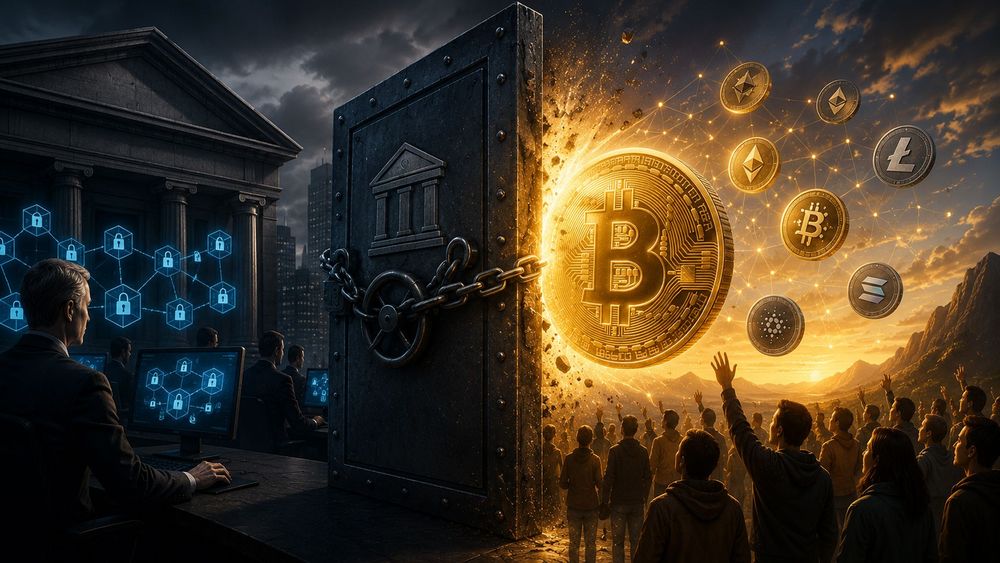
If all these volumes settle inside closed bank ledgers, they will never touch public blockchains - and it is precisely on those that the fees, liquidity, and demand for Ethereum, Solana, and stablecoin tokens rest. According to Citi, the market for tokenized assets could grow to 5.5 trillion dollars by 2030. It is exactly this scenario that worries analysts: capital risks moving into "walled gardens" fully controlled by banks rather than into open networks. We are talking about trillions of dollars that could feed public blockchains but will instead settle inside a closed circuit.
A similar logic is visible in Russia as well: the digital ruble is also, in essence, a closed state ledger controlled by the central bank. The financial world is moving toward systems where every transaction is managed by a specific institution able to halt it at will.
And here lies the main twist. The more tightly finance moves into closed networks, the more valuable the one ledger that answers to no one becomes. A bank account can be frozen, access to a permissioned blockchain can be revoked, and a tokenized deposit still remains in the power of the bank that issued it. Bitcoin, by contrast, offers a neutral network with open access, a scarce asset, and censorship resistance - precisely what the "walled gardens" of large financial players lack.
That is why a warning about closed blockchains turns into an argument for Bitcoin. Its role has evolved step by step: first it was electronic cash, then "digital gold" after the launch of exchange-traded funds, and now a scarce asset available to anyone when every other channel runs through a bank, a custodian, or a compliance filter. In essence, the spread of private networks works as free advertising for the one truly independent ledger.
That said, this narrative has a flip side, one the forecast's own authors honestly warn about. Bitcoin's price still depends not on elegant ideas but on capital flows, macroeconomics, and investors' appetite for risk. The asset's volatility is roughly four times higher than that of global equities, and adding 5% Bitcoin to a portfolio raised its overall risk by 13% - versus just 2% for an equivalent share of gold. It is also telling that BlackRock's flagship Bitcoin ETF held around 45.6 billion dollars in assets despite a nearly 29% drop in value since the start of the year. Bitcoin itself, meanwhile, is trading at roughly half of its all-time high of 126 thousand dollars, set in October 2025.
So what is the bottom line? If tokenization keeps growing while access to it stays closed and reversible at every step, public tokens risk losing their settlement-layer premium - while Bitcoin's uniqueness as neutral and scarce money, on the contrary, shines brighter. But if the market turns risk-off, investors will read the banks' advance as proof that financial giants have taken over the very infrastructure that crypto once promised to replace. As always, real money and flows will decide it in the end, not loud headlines. Yet the very fact that a financial system programmable by only a handful of institutions is already hard to imagine without an asset controlled by none of them says a great deal.
Why does JPMorgan see private blockchains as a threat to Bitcoin?
Because banks moving tokenization, payments, and settlement onto closed networks could drain activity, liquidity, and capital away from public cryptocurrencies and push their valuations lower - a bigger risk, in the bank's view, than sell-offs by large holders.
Which banks and institutions are moving to private blockchains?
Swift is testing tokenized deposit payments with 17 banks including Citi, HSBC, Standard Chartered, UBS, and Wells Fargo. The DTCC depository's tokenization working group has more than 50 members, among them BlackRock, Goldman Sachs, Morgan Stanley, and Nasdaq.
Why is the same trend also seen as bullish for Bitcoin?
The more finance moves into closed, controllable networks, the more valuable a neutral ledger that answers to no one becomes. A bank account can be frozen and permissioned-chain access revoked, while Bitcoin offers open access, a scarce asset, and censorship resistance.
Does this warning mean Bitcoin's price will rise?
Not necessarily. The forecast's own authors note that Bitcoin's price depends on capital flows, macroeconomics, and risk appetite, not narratives. Its volatility is about four times that of global equities, and it trades near half of its October 2025 all-time high of 126,000 dollars.
What are the "walled gardens" in the context of tokenization?
They are closed bank ledgers where tokenized assets settle inside a controlled circuit rather than on public blockchains. Citi estimates the tokenized-asset market could reach 5.5 trillion dollars by 2030, and if that volume stays inside closed networks it never reaches Ethereum, Solana, or stablecoin tokens.
Crypto markets expert and head of content and marketing at EIDEX. Covers market structure, exchange infrastructure and cross-chain trading - turning on-chain data and market shifts into clear, actionable research for traders.