How to Earn Crypto in 2026: 6 Methods with Real Numbers
By EIDEX Team
"How to make money with crypto?" is among the most searched queries globally. Responses typically fall into two extremes: "buy and wait for millions" or "it's all a scam."
The reality sits between these positions. In 2026, multiple functional approaches exist to earn cryptocurrency—each with distinct returns and risks. Below are six methods with actual figures: no exaggerated promises, no referral links.
Method 1: Staking — Crypto Passive Income That Actually Works
Staking involves locking cryptocurrency in a network to maintain its operations and receiving staking rewards in return—comparable to bank interest, but denominated in crypto.
For beginners, this represents where passive income crypto 2026 commences: minimal barriers, no trading expertise required, and predictable returns.
Real yields in 2026:
Ethereum (ETH): average APY between 2.9–3.3%, accessible via Lido, Kraken, and exchanges. Solana (SOL): APY of 6.5–7.5%, reaching 11% on fixed deposits lasting 120+ days. Cardano (ADA): APY of 2.4–5.0%, delegation pools without lock-up periods.
Earnings potential:
A $1,000 ETH staking investment at 3% APY yields roughly $30 annually—approximately $2.50 monthly. Not transformative, but genuine crypto passive income without active trading. With SOL at 7% APY, identical $1,000 generates ~$70 yearly. Bitcoin staking via wrapped BTC protocols operates at 1–3% APY depending on platform selection.
Staking risks:
Price volatility: staking compensation arrives in cryptocurrency, not fiat. If ETH declines 20%, losses occur despite earning 3% APY. Lock-up periods: certain platforms restrict funds for 30–120 days. Smart contract vulnerability: 2025 DeFi exploits cost users $1.5–2 billion aggregate.
Method 2: Trading — The Hardest Way to Earn Bitcoin
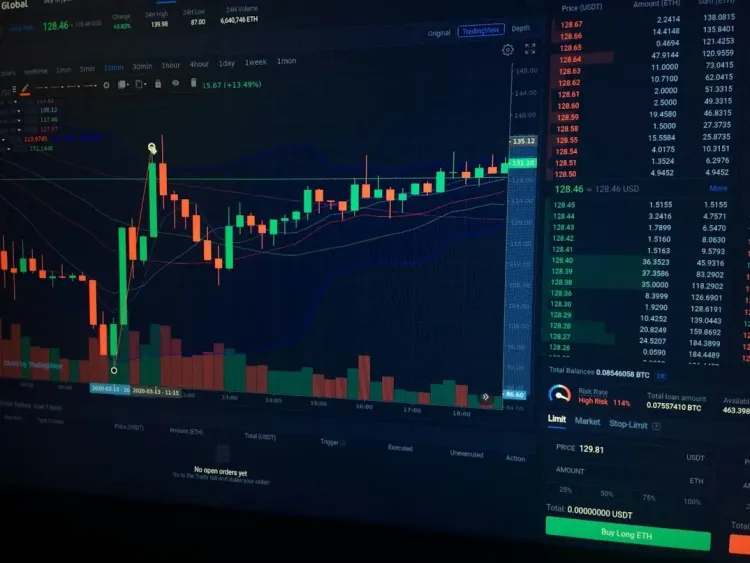
Trading involves purchasing and selling cryptocurrencies to gain from price fluctuations. It appears straightforward. Practically, it ranks as the most challenging method presented here.
Statistics seldom highlighted:
Average daily crypto market volume: ~$40 billion (January 2026). Merely 7% of prop firm traders obtain consistent payouts. Under 15% of retail traders sustain profitability annually. Up to 60% forfeit all or majority capital within the initial year.
Trading categories:
Spot trading — acquire actual crypto, resell higher. The safest category and appropriate starting point for crypto trading for beginners. Accessible on EIDEX with minimal fees.
Margin trading — trade leveraging positions (2x, 5x, 10x), multiplying both gains and losses.
Futures — price-based contracts. Maximum danger, though profitability from declining markets exists.
Realistic earnings: Proficient retail traders generate 2–5% of capital monthly. On $1,000, that translates to $20–50. However: 85% of traders experience losses.
Method 3: Mining — Producing Cryptocurrency
Mining represents how new blockchain blocks become integrated. Miners perform computational labor and earn cryptocurrency as compensation.
Is it feasible in 2026? For most participants—marginally. Home Bitcoin mining in 2026 lacks profitability for the majority. ASIC equipment costs $2,000–3,000 per unit. Recovery period: 6–12 months for industrial operations with electricity at $0.06/kWh. For residential arrangements—1.5–2 years, or indefinitely.
When mining becomes worthwhile: Access to economical electricity (under $0.05/kWh). Industrial-scale operation (10+ machines). Frigid climates enabling complimentary cooling. GPU mining of alternative coins.
Method 4: DeFi Yield Farming — Earning from Liquidity
DeFi yield farming generates income by depositing holdings into liquidity pools or lending venues. Greater intricacy than staking, though potentially superior returns.
Current rates (2026):
Lido (ETH staking): APY of 2.5–3.0%, minimal danger. Aave (stablecoin lending—USDT, USDC): APY of 2–4%, low-medium risk. Aave (ETH, SOL lending): APY of 4–8%, moderate risk. Uniswap (ETH/USDT liquidity): APY of 2–5%, moderate hazard with impermanent loss. Uniswap (volatile pairings): APY of 8–15%, considerable risk.
Impermanent loss explained:
Should you contribute ETH + USDT into a Uniswap pool and ETH appreciated 50%, earnings would fall short of merely holding ETH. This discrepancy gets labeled impermanent loss. With 20–30% price movement, it may consume 10–30% of gains. Simple guideline: elevated APY in DeFi yield farming correlates with elevated danger. When a protocol advertises 100%+ yearly returns—it likely represents a scam.
DeFi risks: Smart contract breaches: $1.5–2 billion in 2025 losses. Impermanent loss consuming 10–30% of earnings. Rug pulls where creators vanish with depositor money. Intricacy: comprehension of pools, slippage, and gas expenditures precedes engagement.
Method 5: P2P Arbitrage — Profiting from Price Gaps
Arbitrage describes purchasing cryptocurrency at a discount on one exchange and vending it at premium rates on another.
Real spreads in 2026:
Between principal exchanges (BTC/USD): 0.1–0.5%—negligible and practically impossible to monetize manually. P2P conduits with domestic currencies: 1–3% margin, stemming from constrained liquidity and compliance obligations. Cross-border arbitrage (USD→USDT→domestic currency): as much as 2–5%, accompanied by threats of account suspension and transfer delays.
Realistic margin: Following expenses, transaction fees, and duration: net margin reaches 0.1–0.3% per transaction. On $1,000, that amounts to $1–3 per cycle. Substantial income demands considerable reserves ($5,000+), automated systems, and numerous accounts.
Method 6: Airdrops — Earn Cryptocurrency for Free
Airdrops constitute cost-free token disbursements by blockchain projects—usually compensating early platform adoption (testnets, transactions, liquidity contribution). During 2024–2025, Arbitrum, Ethena, Hyperliquid, and PENGU distributed tokens surpassing $20 billion aggregate value.
Realistic acquisition ranges:
Casual participation (1–2 protocols): under $50 seasonal—representing 80% of participants. Dedicated engagement (5–10 protocols, testnets): $100–1,000—accounting for 15–18% of participants. Committed early adoption (numerous transactions): $10,000–20,000—representing below 1%. Most cryptocurrency airdrop participants garner under $50.
Airdrop risks: 30% of airdrop initiatives prove fraudulent or substandard tokens. Phishing: bogus "airdrops" designed to compromise your seed phrase. Duration commitment: engaged testnet participation demands dozens of working hours. Transaction charges: testnet and L2 interactions require legitimate expenditure initially.
Comparison: All 6 Methods at a Glance
Staking: 2.5–7.5% yearly, minimal complexity, beginning at $100, moderate hazard—optimal for newcomers seeking crypto passive income.
Trading: 2–5% potential monthly, significant complexity, beginning at $500, substantial danger—exclusively for seasoned participants.
Mining: 0–20% yearly, elevated complexity, beginning at $2,000—suitable for those with economical power access.
DeFi yield farming: 2–15% yearly, intermediate complexity, beginning at $300—meant for sophisticated participants.
P2P arbitrage: 0.1–0.3% per transaction, beginning at $1,000—designed for the patient.
Airdrops: $0–1,000 yearly, unrestricted entry—accessible to everyone contributing time effort.
Key Rules for Anyone Who Wants to Earn Crypto
Never commit beyond your loss tolerance. During 2025, cryptocurrency fraud casualties sustained $6.1 billion losses through Ponzi schemes exclusively.
Diversification: distribute investments across multiple tokens, protocols, and approaches.
Accounting in fiat, not cryptocurrency—"I generated 0.01 BTC" proves insignificant if BTC experienced 40% depreciation simultaneously.
Prioritize safeguarding: two-factor authentication, hardware storage for substantial sums, absolutely never disclose your seed phrase.
Document taxation: jurisdictionally, cryptocurrency earnings remain subject to taxation. Maintain transaction documentation and examine applicable legislation.
Where to Start
The easiest commencing strategy: purchase ETH or SOL on EIDEX, relocate holdings to a staking service, and allow compounding. Zero trading experience necessary. Following market familiarity, investigate DeFi yield farming, P2P arbitrage, or airdrops.
Begin modestly, remain dedicated, and perpetually safeguard capital beyond your loss capacity.
Trade on EIDEX: Bitcoin (BTC) · Ethereum (ETH).
Can I earn money with cryptocurrency without any investment?
Certainly—by participating in airdrops. Complimentary tokens distributed for protocol usage. Nevertheless, 80% of participants obtain under $50 yearly. Meaningful earnings through any crypto methodology demands preliminary capitalization.
What is the safest way to earn crypto?
Staking through established marketplaces including Lido, Kraken, or EIDEX. APY spanning 3–7% with reduced technical vulnerability. Underlying cryptocurrency valuations may still depreciate, necessitating portfolio diversification.
How much do I need to start?
Staking: $100 minimum. Crypto trading for beginners: $500 minimum (otherwise charges overwhelm gains). Airdrops: costless—transaction expenses for interactions solely.
Is it true that most traders lose money?
2026 information: below 15% of retail traders sustain profitability continuously. Roughly 60% lose everything or the preponderance of capital. Trading represents a specialized profession, not an auxiliary enterprise.
Do I need to pay taxes on crypto earnings?
Throughout the majority of jurisdictions, cryptocurrency sales generating profit represent taxable transactions. Percentages fluctuate internationally. Document all exchanges and obtain counsel from regional taxation professionals.